
January has delivered the volatility that was widely anticipated but not only from the expected sources. USD fundamentals remain strong relative to other major currencies but equity markets suggest that the support from US exceptionalism could fade, at least temporarily. As a result, we have squared our long USD Macro positions but remain long JPY expecting more policy normalization from the BoJ.
The USD DXY moved sideways in January, but with significant swings in both directions and mixed individual currency moves. The JPY performed best as the BoJ reconfirmed its commitment to normalize monetary policy, while the GBP was the biggest loser following signs that the economic recovery is crumbling. The widely anticipated source of volatility over the last few weeks was the barrage of US trade policy announcements. The biggest surprise, however, was the release of Deepseek’s latest AI model, which challenges the supremacy of US AI and chip providers.
As outlined in the last FX Monthly, we believe that the base case remains USD supportive. First, the US economy continues to outperform all major economies. Second, the thrust of Trump’s policy agenda has the potential to strengthen growth further through deregulation and tax cuts but is also likely to increase inflationary pressures. Third and as a result, the Fed is expected to lower interest rates less than any other major central bank except for the BoJ. Fourth, the USD remains the dominant safe-haven currency. However, US exceptionalism and USD supremacy are at risk if the implementation of Trump’s policy agenda is on balance more disruptive than beneficial and/or the US high-tech boom stumbles.
Taking stock of the Trump policy rollout
True to his character, Trump has not failed to surprise and shock since his inauguration. Yet, the policy rollout has so far followed the anticipated pattern of multiple overlapping executive orders and legislative initiatives with rolling announcements and deadlines. It is too early to judge the overall impact of the policy rollout on businesses and the economy but there are some developments that could ultimately be more disruptive than beneficial.
• The delay of tariffs on Mexico and Canada is viewed as a relief and the pledges by Mexico and Canada to tighten border controls may lead to a first deal. However, the issue is not just border security. In particular Mexico is likely to face a second tariff attack as Trump tries to push more business operations into the US and to collect the much promised import tax revenues. Moreover, the negative supply effects for businesses from an escalated trade conflict with Mexico could get compounded if the immigration crackdown simultaneously drains the labor supply. The labor and supply-chain links are less entrenched with China and Europe, but both economies are much larger and a prolonged trade conflict risks broader growth inefficiencies and inflation pressures.
• The assault on regulation and bureaucracy is supposed to unshackle the economy but the risk is that the indiscriminate approach destroys the framework of rules and institutions that safeguards orderly business operations and prudential standards.
• There have been no new developments on the tax side since Trumps inauguration. Based on current plans, the latest estimates by the Committee for a Responsible Federal Budget suggest that potential revenues from tariffs will cover at best a quarter of the revenue-shortfall from tax cuts and nearly double the debt growth. The risk is that this leads to a situation in which real interest rates exceed real growth, which would be bad news for government debt sustainability as well as the financial health of businesses and private households.
Watch the equity markets
We have not become AI experts overnight. Yet, we believe that the US is likely to profit the most if the general benefits of the AI race in form of new products and productivity gains offset potential losses for some software and equipment providers. However, the AI boom could also go bust if the AI race leads to overinvestment and insufficient payoffs. The fallout would be particularly bad for the US if in addition the rollout of Trump’s policy agenda is on balance disruptive for the economy.
There are several channels through which the impact of the US policy rollout and AI developments could affect FX markets. In our view, a key channel is relative equity market performance and equity flows. Equity outperformance, both in terms of price gains as well as capital inflows, has been a key feature of US exceptionalism and USD supremacy. Yet, high valuations and crammed long positions in both US equities and the USD create vulnerabilities. Deepseek’s new product launch in January may have been an isolated shock but it could also be the start of a new trend for the relative equity performance.
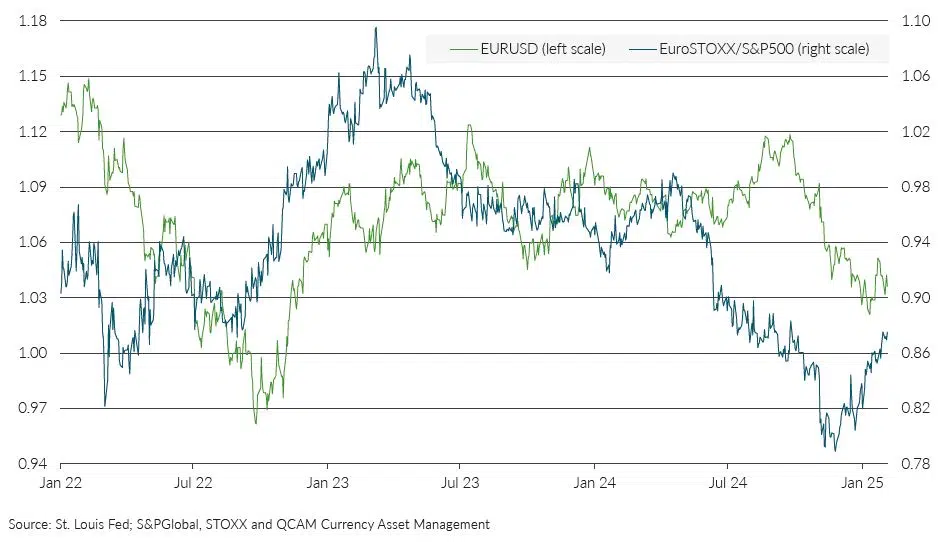
Indeed, US equities have underperformed Euro-area equities since last December (see chart), which probably helped ending the USD’s rally in January despite the generally USD bullish sentiment. It is not clear to us whether the change in relative equity performance will persist but it is reason enough to square our long USD Macro positions at least temporarily.
QCAM MONTHLY | 07.02.2025 | Issue #112

Subscribe now to receive QCAM MONTHLY directly in your inbox and stay informed!
EURUSD and relative equity market performance
Economy & Interest Rates
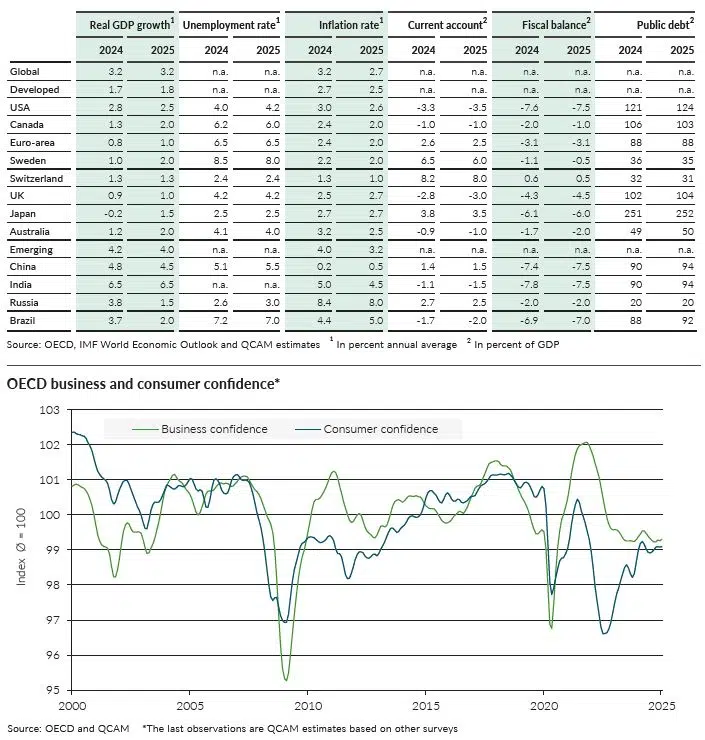
Global business and consumer sentiment has remained stable despite increased policy uncertainty following the inauguration of US President Trump. Overall, we expect global growth this year to roughly match last year’s performance, but with increased uncertainty and some relative changes. Growth in the US is likely to moderate a bit, while most other developed countries will probably see a small pickup in growth. However, US outperformance is expected to continue. Growth in emerging markets will probably moderate as well with China struggling to boost its economy. Disinflation is expected to continue, paving the way for an overall soft-landing scenario, but with some differences, which will also determine the direction of monetary policy. We expect less easing from the Fed, more easing from the ECB and a continuation of policy normalization from the BoJ.
FX Markets
FX Performance vs PPP
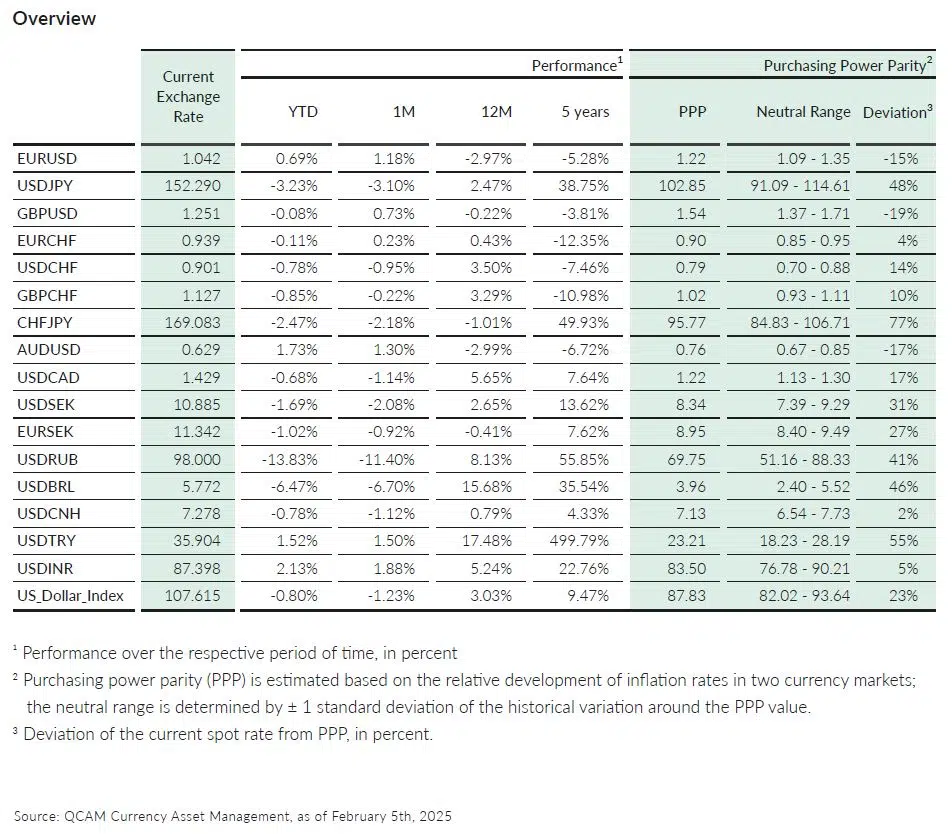
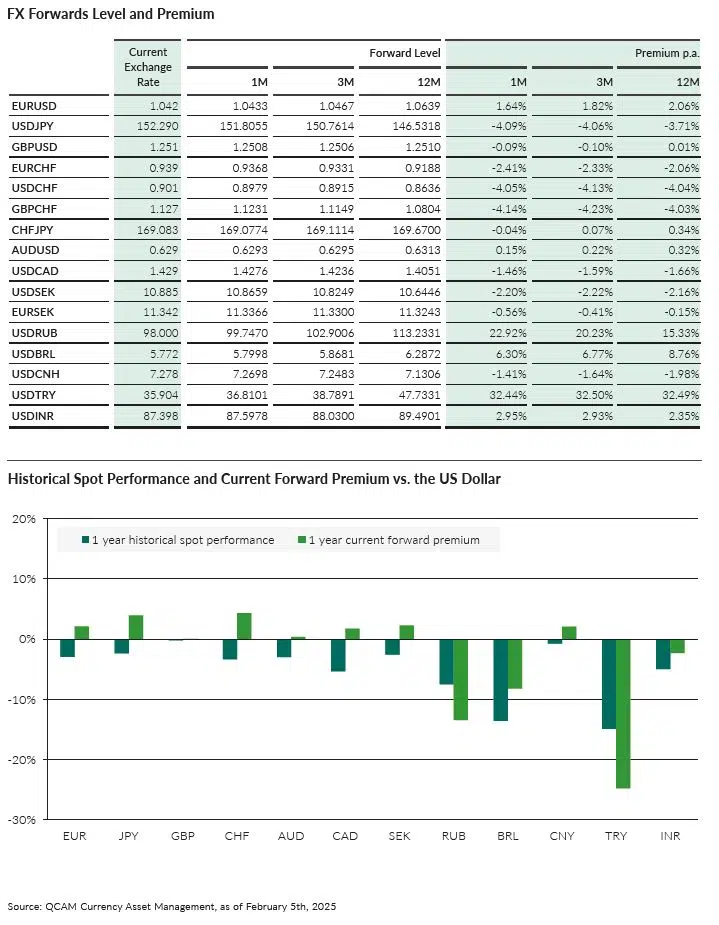
The USD moved on balance sideways in January, but with significant swings. The JPY gained the most versus the USD, while the GBP was the biggest loser. EM currencies were on balance firmer led by strong rebounds of the RUB and the BRL. Net long speculative USD positions increased further and stand at a historical high with EUR, CHF, CAD, AUD and NZD most oversold. Short-term interest rates continued to move lower but forwards point to less future rate cuts than a month ago. The cost of forward hedging versus the USD is no longer declining and remains particularly expensive for JPY and CHF. Actual and implied FX volatilities were mixed but on balance relatively stable and close to their historical averages with USDJPY well above. PPP estimates continue to move against the USD as US inflation remains more resilient and the USD continues to be overvalued versus all major currencies.
Purchasing Power Parity

FX Spot vs. Forwards
FX Analytics
QCAM has an analytical framework to take scalable exchange rate positions. The QCAM exchange rate strategy for each currency pair has three principle components:
• Macro
• Business Sentiment
• Technical
The positioning signals from each component are aggregated into an overall positioning score for each currency pair.
The Macro component consists typically of economic growth, balance of payments, fiscal and monetary policy and in some cases commodity fundamentals. The positions are either discretionary or model driven.
The Business Sentiment component is a rule-based framework built on business surveys.
The Technical component consists primarily of the technical analysis of daily exchange rates (trend following and mean reversion).
The summary table below and the following pages show the QCAM strategy framework and the positioning for the major currency pairs actively covered by QCAM. The tables break each of the three strategies into subcomponents with an indication of the current impact. The charts show the respective exchange rate with past QCAM positions and their scale.
February 2025 — Current positioning
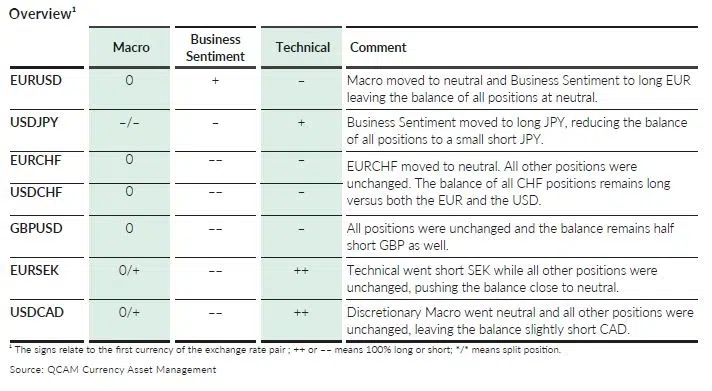
There have been several position changes since the last Monthly. The discretionary Macro went all neutral except for long JPY. Business Sentiment moved to small long positions in EUR and JPY and is on balance moderately long versus the USD. Finally, Technical went short SEK and remains on balance moderately long USD. As a result, the balance of all USD positions remains neutral with a mix of longs versus the GBP and the CAD, shorts versus the CHF and the JPY and neutral versus the EUR. The overall EUR position is short versus the CHF and neutral versus the SEK.