

FX BIAS 2024 Review
2024 was another rollercoaster year in the currency market. FX BIAS managed the first three quarters well but the final quarter was a challenge. Frequent changes in market expectations on the direction of central bank policies and the fallout of the US election have created volatility around business cycle trends. Nevertheless, we believe the performance of FX BIAS in 2024 continues to validate the value of business surveys in FX trading. Given the diverging performance between manufacturing and services since 2023, we are exploring ways to add more service-sector related business surveys to FX BIAS.
2024 was another rollercoaster
2024 was a continuation of the rollercoaster pattern seen in 2023 but with less ups and downs. The broad USD rallied for the first four months through April, only to give back all the gains in the following five months through September (gsee also USD index Chart 1). In the final quarter of 2024, the USD rebounded strongly and broke the upside boundary of the prior two-year trading range (gsee Chart 1 again). The simple narrative links the USD’s movements in 2024 to changes in US inflation figures and the expected and actual stance of Fed policy. Over the first four months of the year, US inflation disappointed to the upside and the Fed postponed the start of the projected easing cycle. US inflation data improved over the subsequent five months and the Fed began the easing cycle with a 50bps rate cut in September. However, inflation figures again deteriorated in the final quarter forcing the market and eventually the Fed to scale back rate cut expectations. The view that the Fed has less room to ease was compounded by the outcome of the US elections as the policies of the incoming Trump administration are widely viewed to be growth-friendly as well as inflationary.
Riding the waves
FX BIAS has done well riding the up and down moves of the broad USD over the first nine months. FX BIAS started 2024 with a net-long USD position which declined subsequently to neutral (gsee Chart 1 again). From May onwards, FX BIAS shifted to a net-short USD position, which peaked in September. This gradual shift from a net-long to a net-short USD position resulted in a nine-months series of un-interrupted positive returns for FX BIAS. By the end of September, the USD-denominated FX BIAS certificate had returned 7.4% over the first nine months of the year. This gain was halved to 3.7% in the final quarter as the USD rebounded while FX BIAS was still net short USD. Fortunately, the loss was dampened as the net-short USD position declined from a peak of over 60% in late September to below 20% at the end of the year. The setback at the end of last year has been disappointing but we continue to believe that the position adjustments of FX BIAS in 2024 validate the value of business surveys in FX trading.
Winners and losers
Table 1 shows the individual currency positions (all versus the USD), the respective exchange rate changes and the resulting performances of the FX BIAS currency components. All individual currency positions have been on average long versus the USD in 2024 except for the JPY (short) and the AUD (neutral). However, positions have varied over the year. For example, the SEK had the largest average long position versus the USD and held that position almost the entire year although not always at 100%. The JPY position in contrast was for 61% of the year neutral, less than 8% long and nearly a third of the year short, resulting on average in a net short position. All currencies depreciated versus the USD over 2024 but again to different extents. The GBP held up best, loosing just 1.7% versus the USD, while the NZD fell the most, followed by the NOK and the JPY. In terms of FX BIAS performance, there have been four winning positions (CHF, JPY, GBP and EUR) and five loosing positions (CAD, SEK, AUD, NZD and NOK).
Chart 2 shows the performance of the individual currency positions over time. By the end of September, five position had solid positive returns (CHF, JPY, GBP, SEK and EUR), two positions returned around zero (NOK and CAD) and two positions were loss making (AUD and NZD). In the last quarter, all positions produced negative returns but at different levels. The long CAD and SEK positions lost the most, both down nearly 10%, while the nearly neutral AUD and NZD positions lost the least. Compared with 2023, encouraging are the consistently positive performances of the CHF and EUR positions (gsee Table 1 again). Positive is also the turnaround of the JPY and GBP from loss making in 2023 to positive returns in 2024. A concern are the consistent losses of the NZD, SEK and NOK positions although their weights in FX BIAS are significantly smaller.
The road ahead
As we pointed out before, we remain confident in the use of business surveys in FX trading. Having said that, there are clearly limits and difficulties as well as structural changes that impact the performance of FX BIAS and require some adjustments:
- Business surveys cannot capture all events in advance and their impact on currency markets. This was clearly the case with the outbreak of the Ukraine war in early 2022 and to some extent was again true for the US election in 2024. We cannot rule out the reoccurrence of unexpected events, but our risk management guidelines allow us to limit possible negative implications.
- Business cycle trends as captured by business surveys and currency markets expectations on the direction of monetary policy can diverge at times and undermine the performance of FX BIAS. Encouraging, however, is that such periods of divergence have so far been temporary and not become prolonged and structural. At the end of 2023, for example, the market was very bullish on Fed easing, while US business surveys still outperformed most of their peers of other major currencies. Yet, the long USD position of FX BIAS, which was hurtful in late 2023, became profitable again in early 2024.
- Service-sector related business surveys may become more relevant. This was not the case when we launched FX BIAS, also because the signal value of the service sector was distorted due to the impact of the corona pandemic. Over the last two years, however, service-related business surveys have outperformed manufacturing surveys and may have in general become more significant for determining business cycle dynamics (see Chart 3). In the case of USDJPY, we have just added service-sector business surveys, which we found useful, and are exploring options to include service-sector business surveys for other currency pairs as well.
- There are signs that commodity related business surveys, especially for oil and gas, have lost value for commodity currencies. As the US has become a net energy exporter itself, changing prospects for energy commodities no longer have a clear and unambiguous impact on the major commodity currencies versus the USD. As this change is probably structural, we are looking for alternative surveys to capture the dynamics of commodity currencies.
For further information and the fact sheet please contact us at info@q-cam.com or +41 55 417 00 50.

More uncertainty than direction
The USD rallied further in December and economic fundamentals and policy developments suggest that the USD has further upside. The start of 2025, however, is dominated by uncertainties surrounding first policy moves. Trump could surprise by being more moderate or more radical. Current rhetoric suggests the later but that could change quickly. In our view, uncertainty is unlikely to fade quickly and that implies more volatility for FX markets in coming months.
The USD DXY rallied another 2.6% in December and broke out of the range of the last two years. The USD advanced versus all major and most EM currencies, with the NZD, the AUD and the JPY suffering the biggest losses. The USD rally was driven primarily by two factors: first, the Fed’s acknowledgement at the December FOMC meeting that it has less room to lower interest rates than previously projected; second, market anticipation that the policies of the incoming Trump administration will further limit the Fed’s ability to ease policy. News, announcements, statements and rumors since the start of the year, however, have created more uncertainty and volatility than clear direction.
The base-case for more USD strength
As we had outlined in our “2025 sneak preview” in the last FX Monthly, the base-case scenario points to further USD strength. This view is based on four factors.
1. US economic growth has been solid through the end of last year and that momentum is likely to carry well into 2025 irrespective of policy steps by the new administration (see also QCAM FX Monthly November 2024). In contrast, most other major economies are struggling to lift growth or stay out of recession (most notably China and some key euro-area economies).
2. The basic thrust of the incoming US administration’s policy agenda has the potential to strengthen growth further through deregulation and tax cuts but is also likely to increase inflationary pressures.
3. And as a result, the Fed is expected to lower interest rates less than any other major central bank except for the BoJ, which is expected to raise interest rates. Current forwards imply that the Fed will lower interest rates by just 32 bps over the next 12 months. All other major central banks excluding the BoJ are projected to lower interest on average at least twice as much and the ECB is even seen to cut rates three times as much as the Fed.
4. The USD remains the dominant safe-haven currency, a feature that could come to its support given prevailing and potentially new geopolitical uncertainties.
Fog of uncertainties
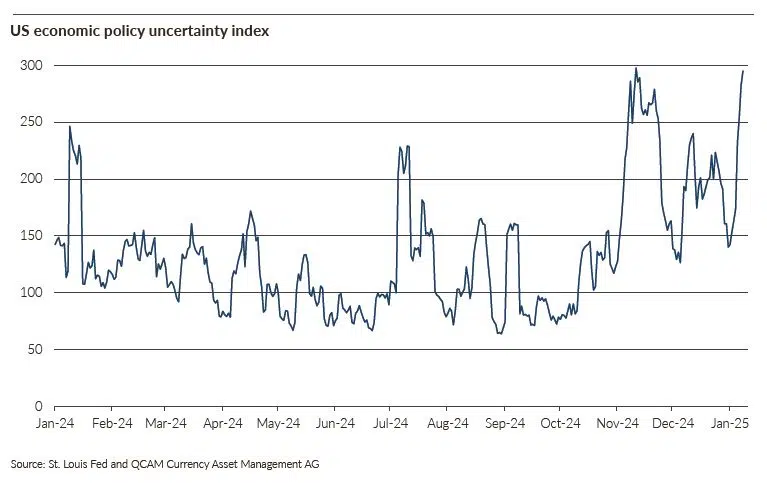
Despite the compelling case for further USD strength, the near-term outlook is clouded by uncertainties. The main source of uncertainty is the rollout of Trump’s economic policy agenda (see Chart). This was highlighted by the turmoil triggered by the recent Washington Post article, which suggested that the implementation of the new administration’s policies may be tamer than feared. The subsequent USD selloff and US Treasury rally showed that the market had priced firmer action. Since then, Trump has missed no opportunity to push his hardline rhetoric. However, the complexity and interconnectivity of the policy agenda as well as the diverging preferences of the players involved besides the president (Senate and House of Representatives) over extent, sequencing and packing suggest that multiple overlapping legislative and executive initiatives with rolling announcements and deadlines are more likely than one clean implementation plan.
The other area of uncertainty is Trump’s foreign policy agenda. How will he deal with the conflicts in Ukraine and the Middle East? Will he put military pressure on Russia to get Putin to the negotiation table and will he deepen the conflict with Iran? Trump’s threats to annex Greenland and Canada are not just populist provocations. A look at the map highlight the geo-economic importance of Greenland and Canada especially in the conflict with China and Russia. Last but not least, there are plenty of uncertainties not directly linked to the incoming US administration, especially in Europe. Germany faces an election in February and the outcome may not be a strong government that is able to fix the country’s economic malaise. France and Austria are in similar positions. Moreover, these are not just problems for each of these countries on their own, but they weaken the overall position of Europe to deal cohesively with the many external and internal challenges.
The leaders not always win
In our view, the fog of uncertainties is unlikely to clear quickly. The result is probably more volatility for financial markets in coming months. Our best guess is that the USD will still be in the lead by the middle of this year, simply because it has the strongest fundamental support for now. However, that could change over time if Trump’s crackdown on trade and immigration curtails growth and boosts inflation while the market loses confidence in the sustainability of US government debt and Fed independence.
US economic policy uncertainty index
Economy & Interest Rates
Global business and consumer sentiment continue to stabilize, but a recovery seems not imminent. Overall, we expect global growth this year to roughly match last year’s performance, but with some relative changes. Growth in the US is likely to moderate a bit, while most developed countries will probably see a modest pickup in growth. However, US outperformance is expected to continue. Growth in emerging markets will probably moderate as well. Disinflation is expected to continue, paving the way for an overall soft-landing scenario, but with some differences, which will also determine the direction of monetary policy. We expect less easing from the Fed, more easing from the ECB and a continuation of policy normalization from the BoJ.

FX Markets
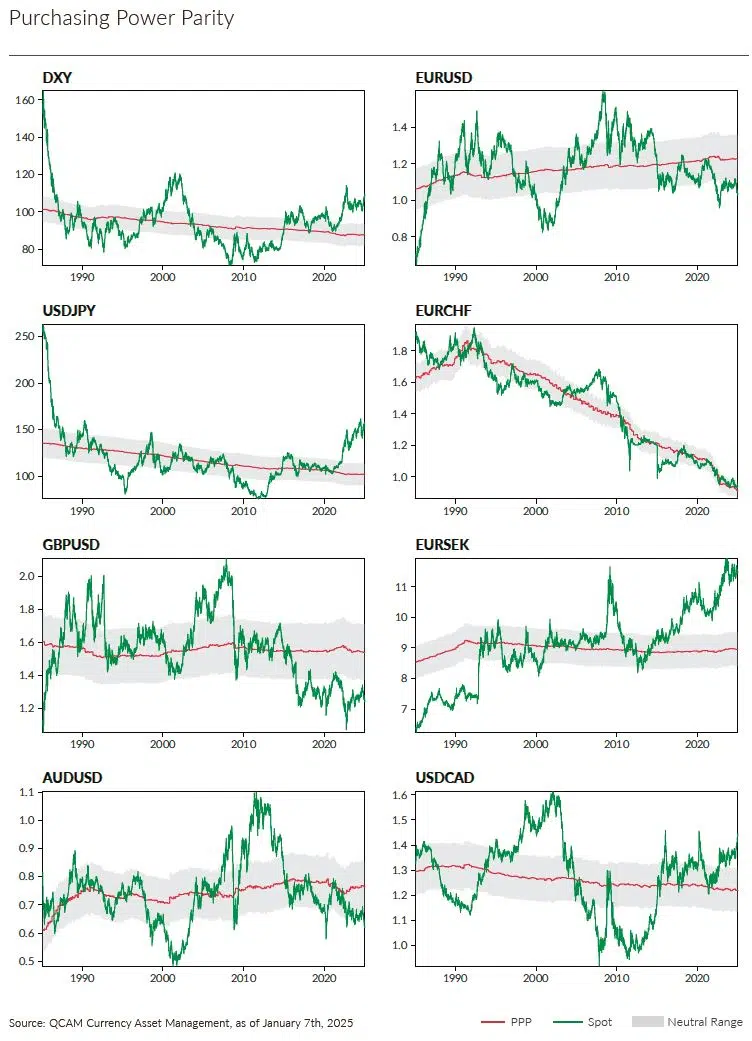
FX Performance vs PPP
The USD DXY gained 2.6% in December following +5.2% in October and November. USD strength was broad-based versus both all other major currencies as well as most EM currencies. Net long speculative USD positions increased further and stand at a historical high with EUR, CHF, CAD and NZD most oversold. Short-term interest rates continued to move lower but some forwards price less future rate cuts than a month ago, notably for the Fed. The cost of forward hedging versus the USD has declined further but remains expensive for JPY and CHF. Actual and implied FX volatilities were mixed but on balance relatively stable and close to their historical averages with USDJPY well above. PPP changes continue to converge as inflation moderates but differences to actual exchange rate levels remain large and the USD continues to be overvalued versus all major currencies.

FX Analytics
QCAM has an analytical framework to take scalable exchange rate positions. The QCAM exchange rate strategy for each currency pair has three principle components:
• Macro
• Business Sentiment
• Technical
The positioning signals from each component are aggregated into an overall positioning score for each currency pair.
The Macro component consists typically of economic growth, balance of payments, fiscal and monetary policy and in some cases commodity fundamentals. The positions are either discretionary or model driven.
The Business Sentiment component is a rule-based framework built on business surveys.
The Technical component consists primarily of the technical analysis of daily exchange rates (trend following and mean reversion).
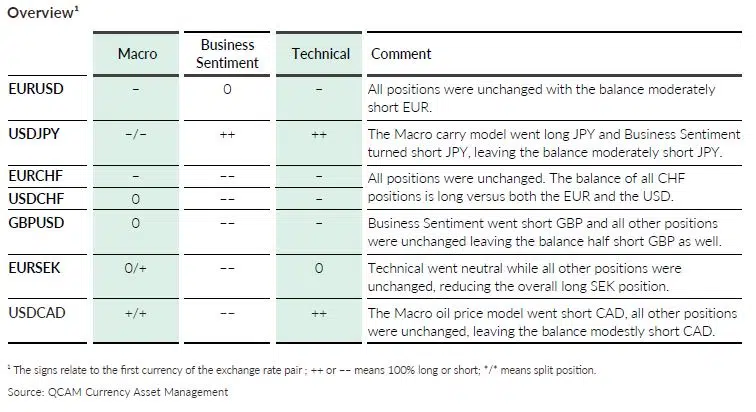
The summary table below and the following pages show the QCAM strategy framework and the positioning for the major currency pairs actively covered by QCAM. The tables break each of the three strategies into subcomponents with an indication of the current impact. The charts show the respective exchange rate with past QCAM positions and their scale.
January 2025 — Current positioning
There have been several position changes since the last QCAM MONTHLY. The discretionary Macro positions all remained unchanged but the Macro carry model went long JPY and the Macro oil price model went short CAD. Business Sentiment turned short both JPY and GBP and is on balance neutral versus the USD. Finally, Technical went neutral SEK. As a result, the balance of all USD positions shifted from neutral to a small long with a mix of longs versus the EUR, the JPY, the GBP and the CAD and short versus the CHF. The overall EUR position is short versus both the CHF and the SEK.
Check out the full QCAM MONTHLY issue for analysis for each currency pair, more charts and tables.
You can also subscribe the QCAM MONTHLY to receive it monthly via email.