

The USD underperformed in Q1 but is still in the range pattern. Policy uncertainty remains too high to forecast a clear trend. In our view, pessimism on the US economy and hopes for an effective fiscal boost in Europe seem both overdone, while the tariff conflict has probably not yet peaked. As a result, we remain neutral except for long JPY.
The USD was the main underperformer in the first quarter of this year. After the 7.9% surge in the final quarter of last year, the USD DXY fell 4.2% in Q1. Looking back, the current USD performance may just be a continuation of the up-and-down pattern since 2023 with the USD DXY currently right in the middle of the range. As we pointed out in the last QCAM Monthly USD weakness is remarkable because it is happening in times of increased uncertainty and risk aversion that typically favor the USD. In fact, the true safe haven was gold gaining 19.5% versus the USD in Q1.
USD weakness in Q1 was accompanied by US equity market underperformance (-4.6%) versus the rest of the world (+5.7%) and suggests that global investors are shifting away from US assets. However, that may just be normal rebalancing given the outperformance of the US equity market (+25.1%) versus the rest of the world (+5.3%) last year.
US downshift
Uncertainty and risk aversion relate undoubtedly to the rollout of the Trump administration’s policy agenda and is visible in deteriorating US economic sentiment indicators and financial market conditions. Policy uncertainty was also the buzz word of Jerome Powell’s press conference after the last Fed meeting. The Fed has adjusted its outlook, cutting the 2025 growth forecast to 1.7% from 2.1% and raising the inflation forecast to 2.8% from 2.5%. We expect US real GDP to be soft in Q1 due to temporary factors and we also lowered our full-year growth forecast, but we think recession is unlikely and US growth will probably continue to outperform most other major economies in 2025.
The deterioration of the growth-inflation trade-off leaves the Fed in a tough position limiting the room to ease even as the economy slows. Jerome Powell stressed the need to pause given increased policy uncertainty but the Fed is not yet willing to shift to a more hawkish stance. This has prompted the market to raise its rate cut expectations for the end of the year from near zero to 75bps and contributed to the USD weakness so far this year. In our judgment, the Fed is unlikely to turn outright hawkish soon, but we think it will take much stronger signs of economic and especially labor market weakness for the Fed to cut interest rates in the face of resilient inflation.
Europe awakes
First-quarter USD weakness was also driven by developments outside the US. Especially events in Europe have played an important role, which is also visible in the outperformance of Euro-area equities. Most importantly, Germany’s likely next coalition government has pushed through constitutional changes to soften the “debt brake” and to engage in “whatever it takes” military and infrastructure spending. Furthermore, Germany is not the only country in Europe that has recognized the need to boost defense spending. EU leaders have agreed on an 800€ billion defense package that allows member states to either borrow directly for defense spending or provide member states with special loans for defense programs.
In our view, these are positive developments but do not simply reverse the balance of power between USD and EUR. In particular, getting a good bang for the Euro requires far-reaching reforms in Germany and elsewhere in Europe. The current coalition negotiations in Germany as well as the growing political polarizations in the rest of Europe suggest that progress is unlikely to come quickly. The fiscal announcements have narrowed spreads between the US and Euro-area interest rates, which has been the main factor boosting EURUSD in March (see Chart). However, US interest rates remain well above Euro-area interest rates and the spreads are again widening, especially at the short end as more ECB easing is still on the cards.
More shoes to drop
As we went to print, “liberation day” just passed and the details of the US tariff increases are not yet clear, but the thrust of the announcement was at the hawkish side of expectations. We fear that the tariff conflict has not yet peaked and that the outcome will probably hurt other countries more than the US. We are skeptical of Trump’s policy agenda but pessimism over the US economy seems to us overdone, while we fear that too much hope is placed on a game-changing fiscal boost elsewhere, especially in Europe. Against this background, we remain reluctant to take strong positions at this point but we stay long JPY, because we believe that Japan is more insulated from geopolitical and tariff conflicts while the BoJ is committed to continue the process of monetary normalization and the JPY is still a good place in times of increased risk aversion.

EURUSD monthly changes and interest rate impact*

Economy & Interest Rates
The recovery in global business sentiment stalled in March and consumer confidence continued to deteriorate amid ongoing heightened policy uncertainty following the inauguration of US President Trump. We have marked down our global growth forecast for 2025 and raised our global inflation forecast. The deterioration in the expected growth/inflation trade-off is most notable in the US and least visible in emerging markets. The global economy is not ripe for a recession but ongoing policy uncertainty and financial volatility increase the recession risk. The deterioration of the inflation outlook limits the scope for monetary easing, but central banks remain more likely to cut rates in response to economic weakness than hike rates amid rising inflation.

FX Markets
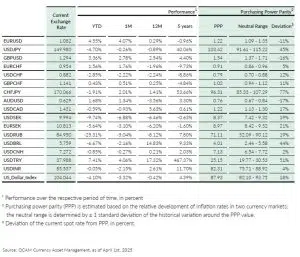
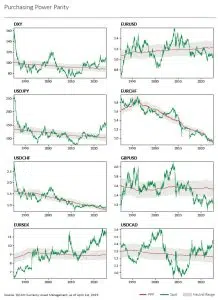
FX Performance vs PPP
The USD DXY declined 3.4% in March with the biggest gains for the SEK followed by the EUR and the JPY and the dollar commodity currencies trailing behind. EM currencies were on balance stronger as well but with more dispersions. Net long speculative USD positions declined from historical highs to neutral with the biggest turnaround in the EUR position from deeply oversold to neutral. Short-term interest rates continued to move lower except for JPY rates, which have crossed the level of CHF rates. The cost of forward hedging versus the USD is no longer declining and remains particularly expensive for JPY and CHF. Actual and implied FX volatilities were mixed but on balance relatively stable and close to their historical averages with only EURUSD and USDJPY somewhat higher. PPP estimates continue to move against the USD as US inflation remains more resilient and the USD continues to be overvalued versus all major currencies.
FX Analytics
QCAM has an analytical framework to take scalable exchange rate positions. The QCAM exchange rate strategy for each currency pair has three principle components:
• Macro
• Business Sentiment
• Technical
Positioning signals from each component are aggregated into an overall positioning score for each currency pair.
Macro component consists typically of economic growth, balance of payments, fiscal and monetary policy and in some cases commodity fundamentals. The positions are either discretionary or model driven.
Business Sentiment component is a rule-based framework built on business surveys.
Technical component consists primarily of the technical analysis of daily exchange rates (trend following and mean reversion).
Ssummary table below and the following pages show the QCAM strategy framework and the positioning for the major currency pairs actively covered by QCAM. Tables break each of the three strategies into subcomponents with an indication of the current impact. The charts show the respective exchange rate with past QCAM positions and their scale.
April 2025 — Current positioning
The discretionary Macro positions remained all unchanged (neutral except for long JPY). Business Sentiment moved long EURUSD and EURCHF, but short USDCHF and the balance of all Business Sentiment positions is moderately short USD. Technical went neutral EURUSD and USDCHF and long GBPUSD and USDCAD with the balance of all Technical positions slightly short USD. The balance of all positions is slightly short USD with the main longs in JPY, CHF and EUR and the biggest short in GBP. The overall EUR position is slightly short versus both CHF and SEK.

Check out the full QCAM MONTHLY issue for more analysis, charts and tables.
You can also subscribe to receive it monthly via email.