

This year has been again a broad USD range market but with a bias towards USD strength and notable cross currency dispersions. In our view, the market’s current bullish USD bias has a strong foundation most notably in terms of interest rate differentials and the direction of central bank policies. The policy agenda of the new US administration may further support the USD but can also backfire and undermine the USD. As a result, USD strength is probably not linear and volatility and cross currency dispersion are likely to rise.
Before venturing into the outlook for 2025, it is helpful to review briefly our outlook for 2024 and the actual outcome. Our key outlook theme for 2024 was that the USD would stay in the broad range that was established in 2023 but with some dispersions. In particular, we felt that the market at the end of last year was too bullish on Fed easing and, thus, too bearish on the USD. In our view, chances that other central banks may cut rates before the Fed were underestimated. Looking back, the USD has moved through three stages so far this year yet stayed in the broad range. The USD rallied from the low side of the range at the start of the year to the high side by the middle of Spring then reversed all the gains until September only to rebound to the top-end of the range over the last two months.
There have been many forces at play, but the most important driver of the USD’s ups and downs and ultimately positive move within the range have been shifting monetary policy expectations vis-à-vis the Fed and other major central banks. The power of monetary policy was also visible in the poor performance of our main cross-currency view: bullish JPY versus bearish GBP. The JPY underperformed because the BoJ dragged its feet longer than expected, while the GBP held up better than feared thanks to the BoE’s reluctance to cut interest rates more than the Fed. Trump’s election victory and the uncertainty over the implementation of his policy agenda will undoubtedly play a key role for currency markets in 2025. But we remain convinced that the transmission channel to FX will continue to depend much on the respective monetary policy implications.
The good case for USD strength
In contrast to the end of last year, the market has now on balance a bullish USD view. We agree that the outlook for the USD remains positive, but not simply because of the Trump policy agenda. As outlined in the previous FX Monthly, US exceptionalism, especially the ability to innovate and raise productivity, is a key support for the US economy and the USD. This advantage is unlikely to fade faster than the structural problems of most other major economies. On the other hand, the US economy is operating at full capacity and inflation, while down from the highs, proves resilient. As a result, the Fed will have to remain cautious, while the need to lower interest rates is bigger in most other major economies.
The bad case for USD strength
The Trump policy agenda is widely expected to add more fuel to the USD rally, but not necessarily for constructive reasons. Trade and immigration restrictions are negative for growth and raise inflation. The US will probably suffer less from a trade conflict and that may support the USD, but it comes at the expense of a weakened global economy. Tax cuts and deregulation may support US growth, but that will probably add to inflationary pressures and further bloat the fiscal deficit. The upshot of Trump’s policy agenda is expected to lead to higher interest rates yet that will only support the USD as long as market confidence is maintained in the Fed’s independence and ability to keep inflation under control as well as the sustainability of US government debt.
Pole position no guaranty for victory
Year-end is marked by illiquidity and position rebalancing. This could be temporarily USD negative given the strong performance of US assets and the USD this year. There is also a sense that the outcome of the election is priced in. On the other hand, uncertainty remains high and new announcement by the incoming US administration as well as events elsewhere could move markets rapidly given reduced liquidity. Irrespective of year-end volatility and uncertainty, the USD starts into 2025 at the pole position, not least because it has the most attractive carry features among the major currencies. Whether it will finish the year first is less clear as the Trump policy agenda bears both chances and risks for the USD.
EUR: The EUR is the most vulnerable both on fundamental grounds as well as with respect to Trump’s policy agenda. The Euro-area struggles with entrenched productivity and productivity problems. Germany and France face political chaos and political fragmentation is spreading throughout the EU. Against that background, swift fiscal action is unlikely, putting the burden on the ECB to support growth. As a result, we expect EURUSD to reach parity in the first half of next year. The main upside potentials for the EUR are a broad-based global recovery and Trump’s policy agenda backfiring.
JPY: The starting position for the JPY is much better. Economic fundamentals are not great, but the economy is reflating and businesses are doing well. Japan is vulnerable to Trump’s trade policy agenda, but it is probably not the prime target. In fact, Trump may seek Japan’s support against China. As a result, we expect the BoJ to continue the process of policy normalization. This process can be bumpy and lead to disappointments, but we view the risk-reward balance as attractive.
GBP: We still think that the fallout from BREXIT is negative for the UK economy and, thus, for the GBP. On the other hand, the UK economy has held up better than feared and is less vulnerable to Trump’s trade policy agenda than the Euro-area. Residual inflation resilience and fiscal expansion argue for BoE caution. However, the GBP is a high-beta and not a safe-haven currency. Thus, GBP up and down-side will continue to depend on overall risk sentiment.
CHF: The CHF remains in a fundamentally strong position. The economy performs well compared to its European neighbors, inflation is inside the 0%-2% target range, the current account surplus remains huge and the CHF’s safe-haven status is uncontested. As a result, we expect the CHF to outperform the EUR. Further SNB rate cuts could cap the upside, but we do not expect the SNB to intervene, not least to avoid angering the new US government and negative balance sheet implications.
SEK: The fundamental support for the SEK is not as strong as for the CHF, but we do not expect the SEK to underperform the EUR. Yes, Sweden is vulnerable to US tariffs, but the government has more fiscal flexibility to counterbalance, while we expect falling interest rates to have a more positive growth impact given the leveraged nature of the household sector.
CAD: The CAD is likely to be another underperformer. Pressure from Trump’s policy agenda is already visible. On the other hand, the economy faces productivity and competitiveness problems and commodities are less likely to help, especially given the recent energy independence of the US. Another concern is political stability and leadership.
AUD: The AUD’s vulnerability to Trump’s trade policy agenda is largely a function of the impact on China. This is a significant downside risk. On the other hand, the Australian economy is performing well and has room to use fiscal policy but is unlikely to lower interest rates aggressively given still elevated inflation.

Economy & Interest Rates
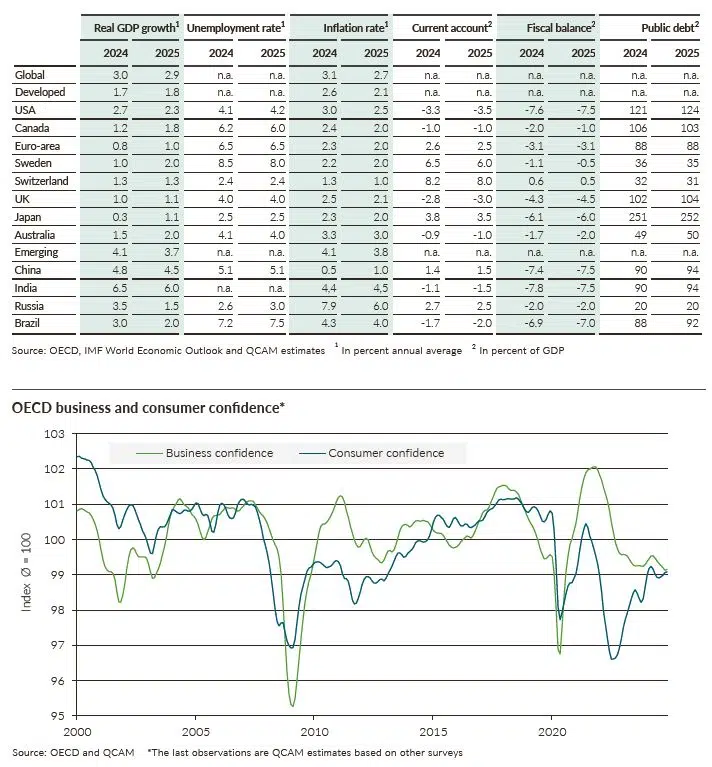
The downswing in global business and consumer sentiment has stabilized, but a recovery seems not imminent. Overall, we expect global growth next year to roughly match this year’s performance, but with some relative changes. Growth in the US is likely to moderate, while most developed countries will probably see a modest pickup in growth. Growth in emerging markets will probably moderate as well. Disinflation is expected to continue, paving the way for an overall soft-landing scenario, but with some differences, which will also determine the direction of monetary policy. We expect less easing from the Fed, more easing from the ECB and a continuation of policy normalization from the BoJ.
FX Markets
FX Performance vs PPP
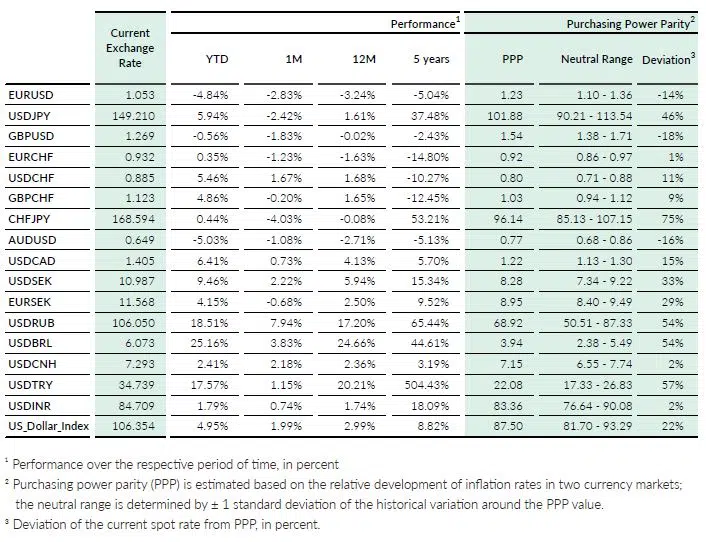
The USD DXY gained 1.9% in November following +3.3% in October. USD strength was broad based but not uniform. The EUR underperformed the most, while the JPY managed to rebound EM currency underperformed driven by steep declines of the BRL, the RUB and the TRY. Net long speculative USD positions increased versus all major currencies except the AUD. Short-term interest rates continued to move lower but some forwards price less future rate cuts than a month ago, notably for the Fed. The cost of forward hedging versus the USD has declined further but remains expensive for JPY and CHF. Actual and implied FX volatilities were on balance relatively stable and close to their historical averages with USDJPY well above. PPP changes continue to converge as inflation moderates but differences to actual exchange rate levels remain large and the USD continues to be overvalued versus all major currencies.

FX Analytics
QCAM has an analytical framework to take scalable exchange rate positions. The QCAM exchange rate strategy for each currency pair has three principle components:
• Macro
• Business Sentiment
• Technical
The positioning signals from each component are aggregated into an overall positioning score for each currency pair.
The Macro component consists typically of economic growth, balance of payments, fiscal and monetary policy and in some cases commodity fundamentals. The positions are either discretionary or model driven.
The Business Sentiment component is a rule-based framework built on business surveys.
The Technical component consists primarily of the technical analysis of daily exchange rates (trend following and mean reversion).
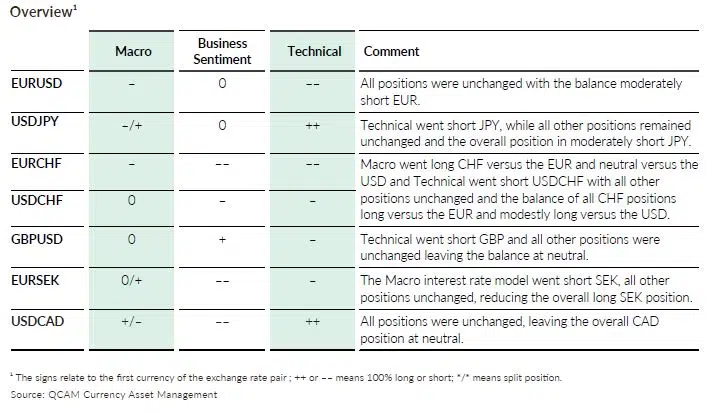
The summary table below and the following pages show the QCAM strategy framework and the positioning for the major currency pairs actively covered by QCAM. The tables break each of the three strategies into subcomponents with an indication of the current impact. The charts show the respective exchange rate with past QCAM positions and their scale.
December 2024 — Current positioning
There have been several position changes since the last Monthly. We switched the CHF Macro positions to short EUR and neutral USD. The Macro interest rate model went short the SEK versus the EUR. Business Sentiment positions were all unchanged and remain overall modestly short USD. Finally, Technical positions shifted to long USDJPY, short USDCHF and short GBPUSD with the balance long USD. As a result, the balance of all USD positions is about neutral with a mix of longs versus the EUR and the JPY, short versus the CHF and neutral versus the GBP and the CAD. The overall EUR position is short versus both the CHF and the SEK.
Check out the full QCAM MONTHLY issue for more analysis, charts and tables.
You can also subscribe to receive it monthly via email.