

Holding liquidity has been costly for many years. Now, cash offers again positive real returns and we believe the fundamental macro and monetary policy conditions behind that will prevail. By transforming the safety of short-term Swiss commercial paper into USD liquidity, the QCAM Short Term Fixed Income Strategy – USD (QCAM STFI-USD) offers investors liquidity, superior returns and reduced credit and market risks. Its favorable risk-return profile and low correlation features make the QCAM STFI-USD also attractive for investors who look for diversification opportunities, especially to reduce volatility.
Cash with positive real return
Holding and managing liquidity has been painful and challenging for corporates and investors since the financial crisis of 2008. Nominal short-term interest rates were close and even below zero. Adjusted for inflation, the return on cash was mostly negative. Furthermore, in addition to holding down interest rates central banks were buying short-term government bills in large amounts, forcing liquidity managers to take more credit and market risk.
This has changed with the rapid rise in interest rates over the last two years. USD cash rates moved from zero to over 5%. Until early last year, inflation was running ahead of interest rates, keeping real cash rates in negative territory. Since then, both actual as well as expected inflation have fallen below interest rates pushing USD real cash rates above 2% (gchart 1). Eventually, central banks will cut interest rates but we think real cash rates will stay positive.
Following the financial crisis of 2008, deleveraging, higher savings and low wage and productivity growth produced a subpar growth and inflation outcome and a significant decline in the real neutral rate of interest (r-star). In response, central banks tried to stimulate the economy by pushing real interest rates below r-star. In our view, this environment has changed. The period of deleveraging is over, investment is rising, savings are falling and structurally tighter labor markets lead to persistently stronger wage growth.
This has two important implications. First, while central banks were trying to raise inflation towards the target level in the past, they will have to lean against the wind to prevent inflation from staying persistently above the target level in the future. Second, r-star itself has probably risen given tighter savings-investment and supply-demand conditions. As a result, we think central banks have now a bias to keep real interest rates positive, probably in the range between 1% and 2%.
More than just holding cash
The prospect of persistently positive real cash rates is good news for anyone who has to hold liquidity. Still, managing liquidity is more than just holding cash. QCAM has been managing USD liquidity for clients since 2012. Starting with USD 800 million, our QCAM STFI-USD has grown to 3 billion USD as of today. Over the years, we have consistently outperformed the main USD liquidity benchmarks. We have achieved this outperformance without taking any extra credit or market risks. Instead, we have focused on top-rated issuers outside the US, notably in Switzerland, which has generated attractive liquidity and hedging premia. Given the long and successful track record of the QCAM STFI-USD and the restored attraction of liquidity products, we have decided to offer the QCAM STFI-USD to a wider client base and to launch it as USD short-term fixed income fund regulated in Switzerland.
Our Swiss liquidity management foundation
The QCAM STFI-USD was developed for our clients who have USD liquidity but are located outside of the US, notably in Switzerland. Given QCAM’s own location and expertise in the Swiss market, the core of our short-term fixed income investments (at least 50%) are with top-rated Swiss public-sector entities (more than 90% is rated A-1 or better). Most issuers are also protected by state-level guarantees. Besides the strong individual credit ratings, we believe that the credit exposure is further supported by Switzerland’s healthy financial, fiscal and balance of payments position and general safe-haven character. In addition to the core holdings in Switzerland, we invest selectively in similar top-rated public-sector issuers in other countries such as Denmark, Norway and Japan.
Most assets we buy are securities with maturities between 1 and 6 months. These assets are by nature less liquid during their term compared to US Treasury Bills, which creates an attractive premium. Still, we guarantee daily liquidity. Less than 20% of the assets we buy are USD denominated. However, we take no FX risks and hedge all other currency exposures into USD at all times. The hedging is an additional source of performance enhancement as the structural global demand for USD keeps the cross currency swap basis of the issuer currencies in our portfolio versus the USD mostly below zero.
The last feature of the QCAM STFI-USD is Best Execution in our clients’ interest. QCAM is an independent manager with strong access to a wide range of issuers, FX market makers and competitive pricing. Our interests are 100% aligned with our clients’ interest (no principal agent conflicts and hidden fees). We believe that the unique performance features of the QCAM STFI-USD will persist in the new interest rate environment and will continue to generate attractive returns for clients who place utmost importance on top credit quality and best execution.
Liquidity as a diversification tool
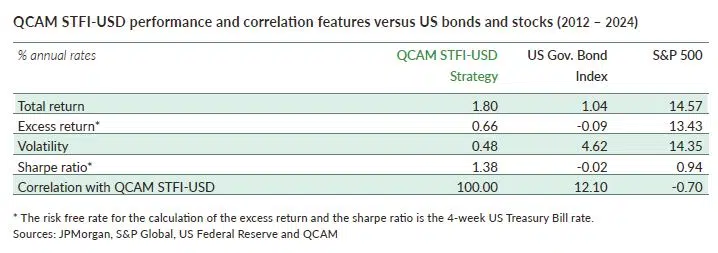
Most of our clients hold liquidity for statutory and precautionary reasons. However, we believe that the risk-return profile and correlation features also qualify the QCAM STFI-USD as an independent asset that helps diversify investment portfolios. The table below shows total and excess returns, the volatility (standard deviation) and the Sharpe ratio (volatility-adjusted excess return) of the QCAM STFI-USD versus US government bonds and stocks as well as the correlation of the QCAM STFI-USD with US government bonds and stocks over the period from January 2012 through May 2024.
Important from a liquidity management perspective is that the QCAM STFI-USD has produced an average annual excess return of 66 basis points over the last 12+ years. In other words, QCAM STFI-USD is visibly better than just rolling Treasury Bills. The total return of QCAM STFI-USD is higher than that of US government bonds but, as would be expected, lies well below the total return of the S&P500. However, the QCAM STFI-USD has by far the lowest volatility. Indeed, the Sharpe ratio (volatility-adjusted excess return) of the QCAM STFI-USD is even higher than that of the S&P500 and much better than the Sharpe ratio of US government bonds. Of course, performance varies over such a long time span. Chart 2 shows the 12-months rolling Sharpe ratio of the QCAM STFI-USD versus US government bonds and stocks. Over the last 12+ years, the QCAM STFI-USD was not always the best performer, but unlike US bonds and stocks, the performance of the QCAM STFI-USD has been more stable and was never negative on a 12-months basis, which also means that it was consistently better than just rolling Treasury Bills.
The QCAM STFI-USD had also a very low or close to zero correlation with US government bonds and stocks over the last 12+ years (table again). Of course, that does not exclude high co-movements in certain time periods. Chart 3 shows the 12-months rolling return correlation of the QCAM STFI-USD with US government bonds and stocks since 2013. Indeed, there have been periods of positive co-movements, especially with US government bonds between mid-2017 and mid-2021. However and very importantly, there have been barely any periods of simultaneous negative returns. In fact, the QCAM STFI-USD had never a negative return when the S&P500 was down over the month and there were only three months over the last 12+ years when the QCAM STFI-USD and US government bonds had simultaneous negative returns, and in those three incidences the worst monthly performance of the QCAM STFI-USD was -4 basis points. In contrast, US government bonds and stocks had simultaneous negative co-movements in 17% of the months since 2012 with an equal-weighted average return of -2.4% per month.
As a result, adding the QCAM STFI-USD to any portfolio of US government bonds and stocks is set to reduce the overall portfolio volatility. In particular, by replacing a portion of the bond allocation with the QCAM STFI-USD will probably reduce the overall portfolio volatility without harming the total return. In sum, the QCAM STFI-USD is attractive for both liquidity and portfolio management purposes. It offers daily liquidity and superior returns without taking any extra credit or market risks and provides attractive portfolio diversification opportunities.


No Midsummer Night’s Dream
The USD rebounded in June supported by hawkish Fed commentary, political uncertainty in Europe and disappointing economic news from Japan. Political events are likely to create more volatility in the second half of the year, but the underlying themes of relative growth performances and central bank policy paths should continue to shape the broad direction in FX markets. In our view, that means the USD will stay in the broad range that prevailed since early 2023, but with more volatility.
The USD DXY rose 1% in June and was up 4.3% in the first half of the year. Despite the positive performance, the USD DXY stayed inside the range that has prevailed since early 2023 (101 to 106). In our 2024 sneak preview from December 2023, we argued that the market’s bearish USD bias was too reliant on Fed rate cut expectations and ignored potential uncertainties. Instead, we predicted a continuation of the USD range environment. Our view has broadly panned out, but the strength of the USD within the range has surprised us as well. In hindsight, this was primarily owed to the disappointing US inflation data in the first quarter and the Fed’s hawkish response which ended with a 50 basis points reduction in the 2024 median rate cut projection by FOMC members. But idiosyncratic reasons also played a role, like those behind the JPY’s collapse.
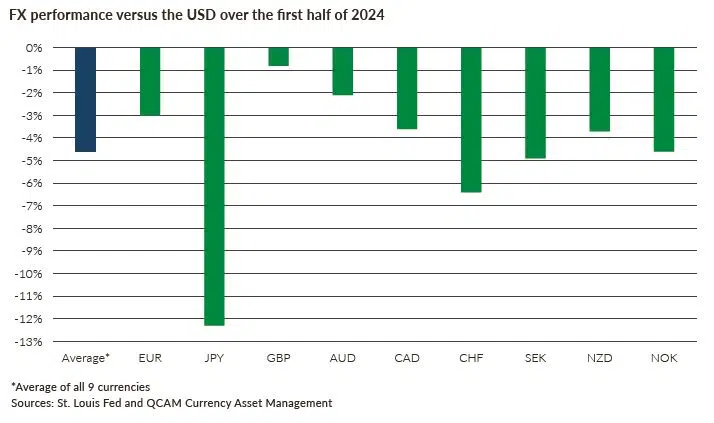
Individual currency performances have varied significantly in the first half of the year (see Chart). All major currencies were down versus the USD, but the performance spread was huge. By far the biggest loser was the JPY. Our expectation, that the BoJ would be more pro-active in normalizing the policy stance was wrong. In addition, the Japanese economy started to fall behind. While we raised our 2024 global growth forecast since the end of last year by nearly one percentage point, our growth forecast for Japan dropped from 1% to zero. The second underperformer, although with a large gap, was the CHF. The SNB used the rapid decline of inflation to well below 2% to relax policy both in terms of cutting interest rates before any other major central bank and by correcting the CHF’s 7% appreciation versus the EUR in 2023. The GBP held up by far the best, which proves its value as a risk-on currency despite the UK’s many challenges.
Main themes still alive
Looking ahead, we believe that the two major themes that framed our currency outlook so far this year remain relevant for the second half of the year, namely relative growth performances and central bank policy paths. On the growth side, we note that the global recovery has not run out of steam, but the momentum has declined with some countries struggling to advance further (e.g. Japan). However, we still see US outperformance declining. This is most evident in the positioning of our FX BIAS strategy, which is based on the relative performance of business sentiment surveys. FX BIAS is currently net short USD with longs in EUR, GBP, CHF, SEK, NZD and NOK as well as neutral positions in JPY, AUD and CAD.
On the monetary policy side, the picture is largely reverse. We expect most major central banks to cut interest rates earlier and by more than the Fed. Simplified, that reflects faster and more sustained disinflation progress as well as stronger economic pressure to ease policy. The main exceptions are the BoJ, which we expect to tighten but not convincingly, and the RBA, which we think will stay put or may even tighten further in response to stubbornly high inflation. Thus, we expect the USD to maintain its overall yield advantage, with likely improvements versus most European currencies.
But add more political volatility
What is likely to change in the second half of the year is more volatility caused by political events and uncertainties. June provided already some foretaste with the outcome of the EU election and the subsequent French snap election. Next comes the UK election and the US elections are also heating up (e.g. first Biden – Trump debate). Furthermore, there are important German state elections in the fall. In our view, the general outcome will be increased domestic as well as international political instability through fragmentation and polarization, more fiscal slippage and trade tensions.
Looking at the very near term, the market may respond with relief if the Rassemblement National fails to win a majority in the second round of the French election. This may give the EUR a temporary boost. However, that still makes the formation of a strong government unlikely and weakens the position of the French President, which complicates not only the domestic situation in France, but also undermines the leadership situation within the EU at a time when it is badly needed (e.g. Ukraine, immigration, trade policy, fiscal rules).
The USD is set to benefit from political uncertainty in Europe and the upside will probably grow the more likely a Trump victory appears. The main risk for the USD is its overvalued and overbought position. However, it will probably take an economic downturn and/or a big dovish Fed policy shift to trigger a significant USD downfall.
Economy & Interest Rates
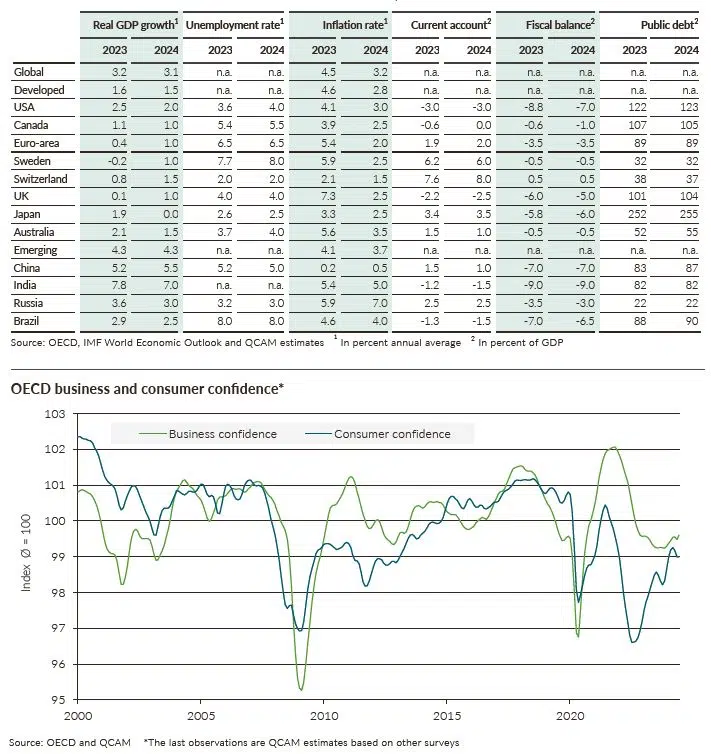
Global growth conditions continue to improve slowly with US outperformance narrowing further. Notably, growth forecasts in Europe have been raised, but Japan’s outlook has deteriorated. The process of disinflation continues but slowly with the latest figures softer after prior bumps. Overall, soft-landing (moderate growth and lower inflation) remains the favored scenario of the market for the US and the global economy. However, uncertainty and the risk of a hard-landing or no-landing with an inflation rebound remain significant, leaving a range of possible monetary policy implications. In our view, most easing is likely to occur in Europe led by the ECB, while the Fed will probably ease later and less. The BoJ is expected to tighten policy but not forcefully.
FX Markets
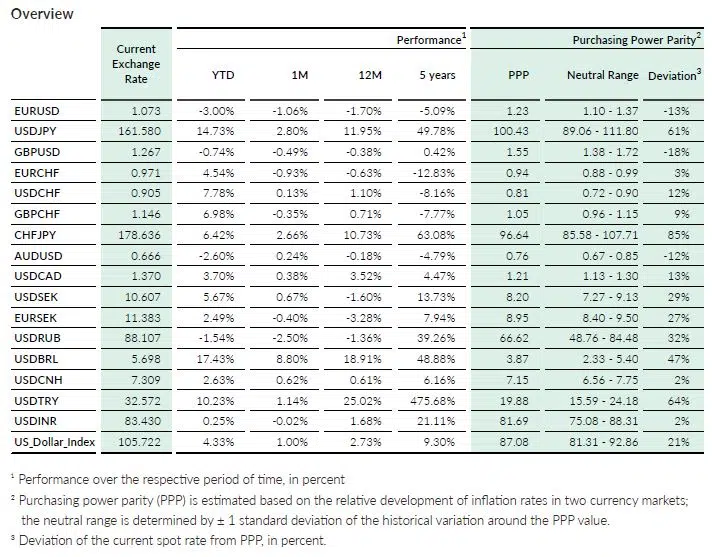
The USD DXY rose 1% in June, but with uneven gains versus other major currencies. The JPY was the main loser, while the AUD held up best. EM currencies underperformed on balance their major peers dragged down by the BRL. Overall speculative positions remained overweight USD with the JPY and the CHF looking most oversold. Short-term interest rates moved a bit lower and forwards price further rate cuts from most central banks over the next 12 months. The cost of forward hedging versus the USD has declined a bit but remains expensive especially for JPY and CHF. Actual and implied FX volatilities were on balance a touch higher but remain below historical levels with the notable exception USDJPY. PPP changes continue to converge as inflation moderates but differences to actual exchange rate levels remain large and the USD continues to be overvalued versus all major currencies.
FX Analytics
QCAM has uses an analytical framework to take scalable exchange rate positions. The QCAM exchange rate strategy for each currency pair has three principle components:
• Macro
• Business Sentiment
• Technical
The positioning signals from each component are aggregated into an overall positioning score for each currency pair.
The Macro component consists typically of economic growth, balance of payments, fiscal and monetary policy and in some cases commodity fundamentals. The positions are either discretionary or model driven.
The Business Sentiment component is a rule-based framework built on business surveys.
The Technical component consists primarily of the technical analysis of daily exchange rates (trend following and mean reversion).
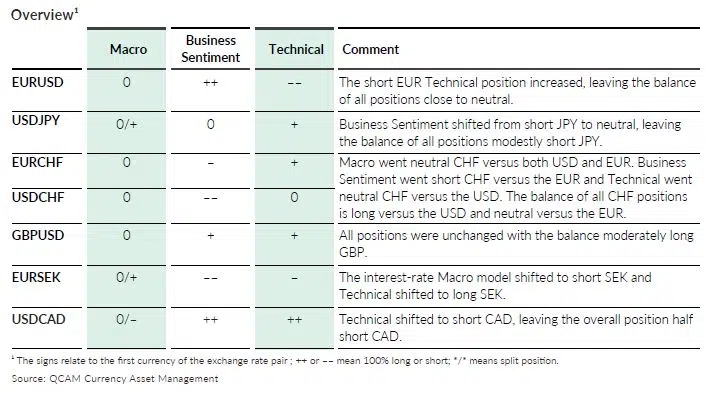
The summary table below and the following pages show the QCAM strategy framework and the positioning for the major currency pairs actively covered by QCAM. The tables break each of the three strategies into subcomponents with an indication of the current impact. The charts show the respective exchange rate with past QCAM positions and their scale.
Current positioning — July 2024
There have been a few signal changes since the last MONTHLY pushing the balance of all positions from slightly short USD to neutral. On the discretionary Macro side, all positions remained unchanged. Business Sentiment went from short JPY to neutral and from long CHF versus the EUR to short. On balance, Business Sentiment is now modestly short USD. Technical went neutral CHF versus the USD, short CAD versus the USD and long SEK versus the EUR. Overall, the small USD short position versus the balance of all other currencies shifted to neutral, led by shorts versus the CHF, the EUR and the GBP. The USD has the largest long position versus the CAD and the largest short position versus the CHF. EUR is neutral versus the CHF and long versus the SEK
This is just an excerpt from the QCAM MONTHLY. You can open or download it to obtain all the analyses and data.
Source, Content, concept, and layout: QCAM Currency Asset Management AG, Zug
Editorial deadline: July 4th, 2024
Market data: July 2nd, 2024