

Donald Trump’s sweeping election victory paves the way for far-reaching policy changes. This could enhance the USD’s exceptionalism or bring it to an end. Much will depend on the persistence of US economic outperformance as well as the market’s confidence in Fed independence and the sustainability of US government debt.
As we go to print, Donald Trump has won the presidency and the Republicans have won the Senate and most likely the House of Representatives as well. As a result, the new Trump government is in a strong position to implement its policy agenda: 1) introduce across the board trade tariffs, 2) close the borders to immigrants and deport illegal immigrants, 3) cut taxes and 4) deregulate transportation, environmental and energy policies. Most likely, this is not all going to happen immediately and there are legislative and legal hurdles, but a fundamental policy shift is in the making and will have a profound impact on the US economy as well as the rest of the world and financial markets. For the USD, much will depend on US economic outperformance as well as the credibility of the Fed independence and government debt sustainability.
US economy on solid ground
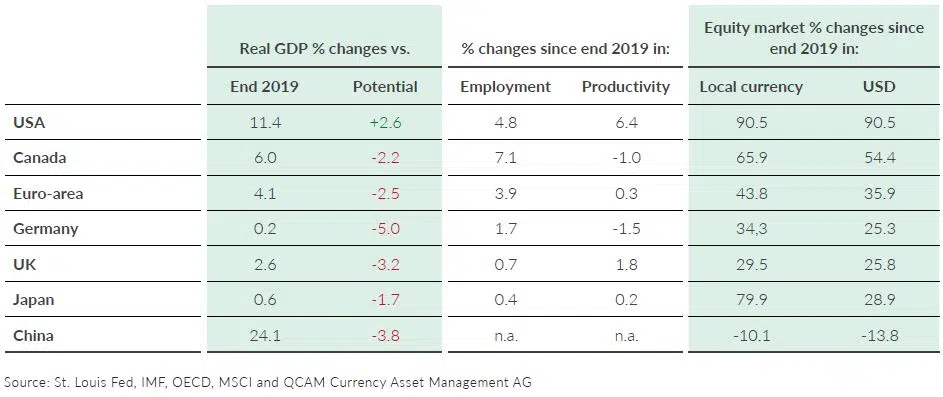
The US has recovered much stronger than any other major developed economy since the start of the pandemic (see table). Importantly, it outpaced its own potential, while all other major developed economies have fallen behind their potentials. China has grown even more than the US, but it also fell behind its potential. In nominal USD terms, moreover, the US has grown faster than China over the last three years.
US strength is built on strong employment and productivity growth (see table). However, this is concentrated and not broad based. Four fifth of the employment growth comes from foreign workers, which account for less than one fifth of the US work force. On the productivity side, less than 5% of the employees account for more than half of the total productivity growth. Not surprisingly, much of that is concentrated in IT services. Such concentration bears risks and could lead to excesses such as during the dot.com bubble. However, the US has a unique ability to overcome such setbacks thanks to its structural capacity to constantly create and distribute new products and services.1
US strength is also built on high business profit margins, which means that firms are in a favorable position to hire and invest. In turn, businesses hiring is good for household incomes and spending. Furthermore, households have done a good job putting their balance sheets in order, which is visible in low debt service payments. Finally, important support comes from the shale-gas boom, which has made the US energy independent.
What could go wrong?
One concern is the current AI boom, which could end in a bubble. The bigger threat, however, comes from policy. The aim of the Trump policy agenda is to make the US economy even stronger through tax cuts and deregulation and to protect it from foreign competition and immigrants. In our view, trade and immigration restrictions are negative for growth and raise inflation. Tax cuts and deregulation may support growth, but that will probably add to inflationary pressures as well and further bloat the already large fiscal deficit. Ironically, US exceptionalism could still continue at least for a while despite these negatives, because the US may suffer less than the other major economies from the negative policy implications (notably in trade) and because the US is unlikely to lose its productivity advantages abruptly, while other countries will probably not overcome their structural problems quickly (e.g. Europe and China).
Squared or pared?
US economic exceptionalism has been a key driver of US financial and USD outperformance. The US equity market has on balance outperformed other major
equity markets by more than 2:1 over the last five years and even more so in USD terms (see table). In our view, the USD may continue to do well if US economic exceptionalism is sustained at least for a while despite the negative policy implications. However, that also requires ongoing market confidence in the Fed keeping inflation under control and in the sustainability of US government debt. The combination of loose fiscal policy and tight monetary policy boosted the USD during the first term of the Reagan administration. Back then, however, Fed independence under Paul Volker was unquestioned and the debt/GDP ratio was about a quarter of what it is now.
In the short term, we think the USD will benefit from the market’s favorable view on the implications of Trump’s policy agenda (higher growth and interest rates). But that is likely to change over time, if Trump prevents the Fed from tightening policy in the face of rising inflation while the Treasury announces at the same time ever larger bond auctions.

US economic and financial performance in comparison
Economy & Interest Rates
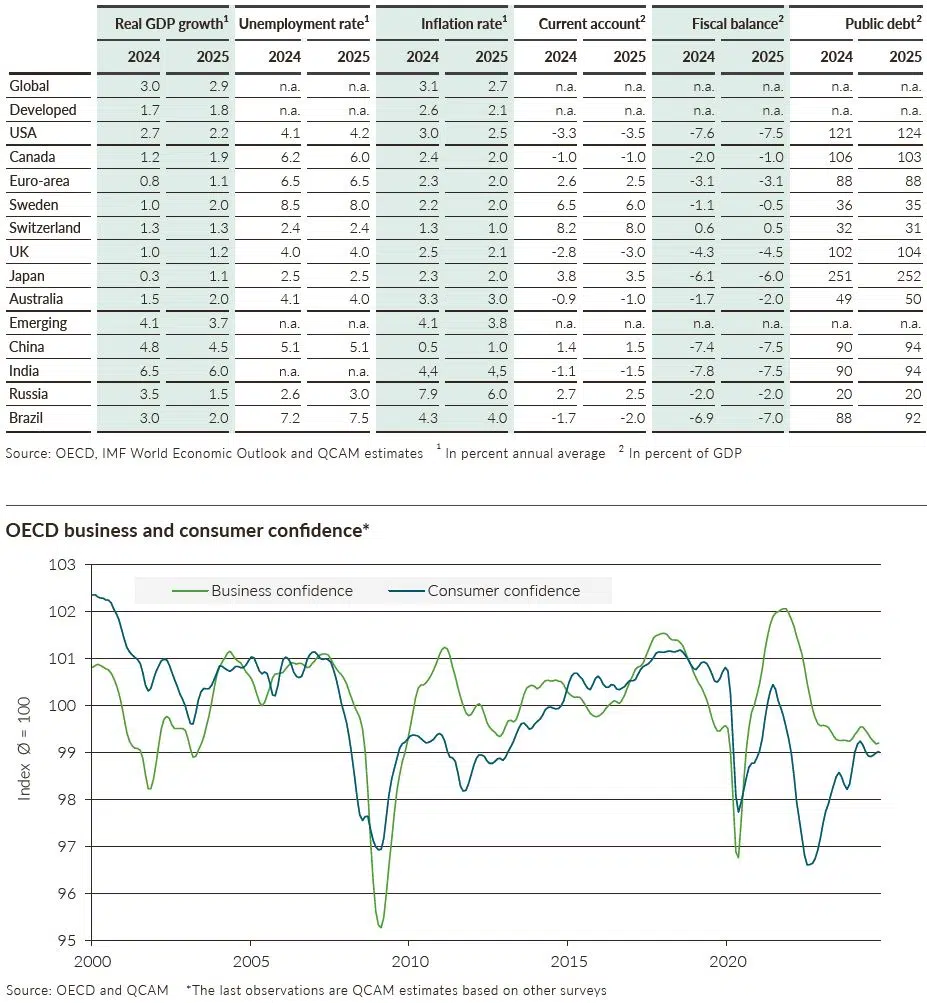
The downswing in global business and consumer sentiment has stabilized, but a recovery seems not imminent. Overall, we expect global growth next year to roughly match this year’s performance, but with some moderation. Growth in the US is likely to moderate, while most developed countries will probably see a modest pickup in growth. Growth in emerging markets will probably moderate as well. Disinflation is expected to continue, paving the way for an overall soft-landing scenario, but with some differences, which will also determine the direction of monetary policy. We expect less easing from the Fed, more easing from the ECB and a continuation of policy normalization from the BoJ.
FX Markets
FX Performance vs PPP
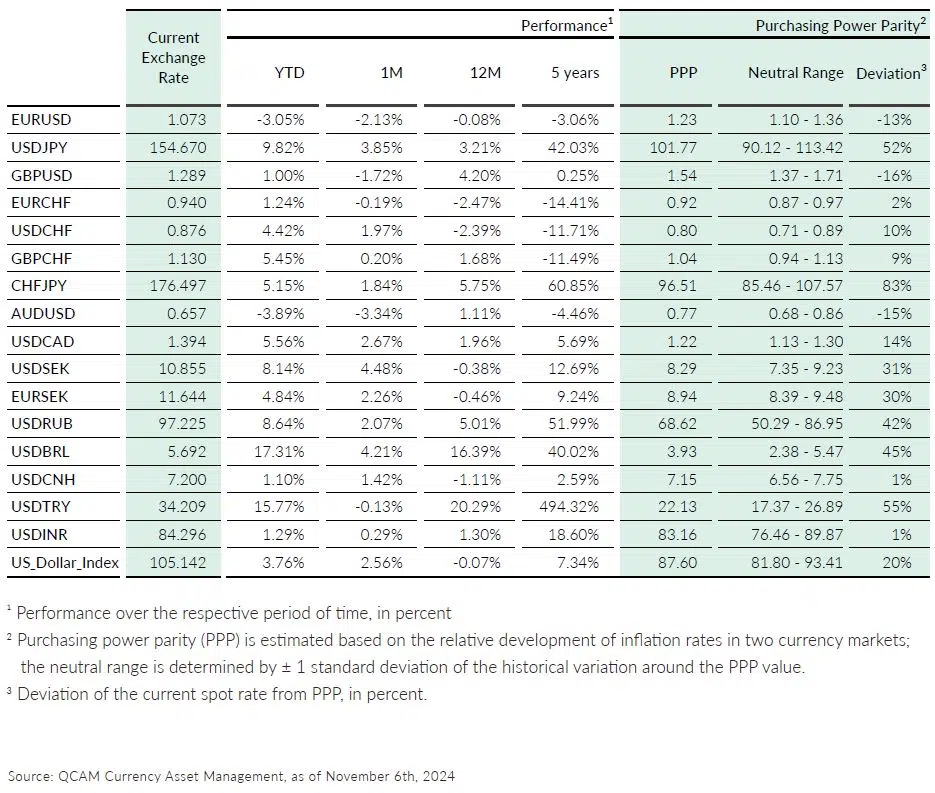
The USD DXY gained 3.3% in October and more in early November. USD strength was broad based but most extreme versus the JPY. EM currency performance was mixed with CNH and INR holding up well but BRL and TRY falling sharply. Speculative positions changed significantly, with USD and AUD most overbought and EUR, CHF and CAD most oversold. Short-term interest rates continued to move lower but some forwards price less future rate cuts than a month ago, notably for the Fed. The cost of forward hedging versus the USD has declined further but remains expensive for JPY and CHF. Actual and implied FX volatilities were on balance relatively stable and close to their historical averages with USDJPY well above. PPP changes continue to converge as inflation moderates but differences to actual exchange rate levels remain large and the USD continues to be overvalued versus all major currencies.

FX Analytics
QCAM has an analytical framework to take scalable exchange rate positions. The QCAM exchange rate strategy for each currency pair has three principle components:
• Macro
• Business Sentiment
• Technical
The positioning signals from each component are aggregated into an overall positioning score for each currency pair.
The Macro component consists typically of economic growth, balance of payments, fiscal and monetary policy and in some cases commodity fundamentals. The positions are either discretionary or model driven.
The Business Sentiment component is a rule-based framework built on business surveys.
The Technical component consists primarily of the technical analysis of daily exchange rates (trend following and mean reversion).
The summary table below and the following pages show the QCAM strategy framework and the positioning for the major currency pairs actively covered by QCAM. The tables break each of the three strategies into subcomponents with an indication of the current impact. The charts show the respective exchange rate with past QCAM positions and their scale.
November 2024 — Current positioning
There have been several position changes since the last QCAM Monthly. On the Macro side, we went long the USD versus the EUR, the CHF and the CAD. The Macro interest rate model also went short the JPY versus the USD. Business Sentiment went neutral EUR and JPY. Finally, Technical positions shifted to short EURUSD, neutral USDJPY and USDCHF, long SEK versus EUR and short CAD versus USD. As a result, the balance of all USD positions is now about neutral with a mix of longs versus the EUR and the shorts versus the GBP. The overall EUR position is short versus both the CHF and the SEK.

Check out the full QCAM MONTHLY issue for more analysis, charts and tables.
You can also subscribe to receive it monthly via email.