
The USD weakened further in September triggered by more Fed rate cut expectations. US soft-landing, Fed easing and China stimulus all point to further USD weakness. However, there are several risks that could lead to a different outcome. As a result, we believe the USD will stay in its current range until the end of the year but not necessarily uniformly against all currencies. In our view, the AUD and the JPY have good chances to outperform.
The USD DXY fell 1.1% in September to the low-end of its two-year range as the market bet on more Fed easing. USD weakness was broad-based but most noticeable versus high-beta currencies such as the AUD and the GBP. The performance of EM currencies was mixed, but on balance positive as well with the BRL and the ZAR outperforming all major currencies. More broadly, September was not a bad month for financial markets as it is often the case (see our previous QCAM Monthly). The start was gloomy but then sentiment recovered, stocks rallied, Treasury yields fell, gold rose and most currencies appreciated versus the USD.
The start of broad-based USD weakness …
October has started again gloomy due to the escalation of hostilities in the Middle East. Geopolitical risks aside, however, the last few weeks have contained a string of good news that if realized could result in broad-based USD weakness, also given its overvaluation against most major currencies (see pages 5 & 6). First, more signs that the period of US exceptionalism is ending with a soft landing for the US and global economy in reach. Second, the Fed has started to ease and is projecting to lower the Funds rate to neutral (around 3%). Third, China has announced a new stimulus package with the promise to do more if necessary. The reasons for optimism are justified, but we also see significant risks that could lead to very different outcomes at least in the near term.
… is not assured
We agree that soft-landing is the most likely scenario for the US and global economy, but we also think that the probabilities of the risks around the soft-landing scenario are significant. For the US, economic and inflation resilience as well as recession are both in play and rather supportive for the USD. Resilience would mean more US exceptionalism while recession would probably trigger risk aversion. Furthermore, we are sceptical that the Fed will cut as much as the market currently expects even if soft-landing is achieved. Supply-demand dynamics for goods, services and capital have changed and require, in our view, tighter monetary conditions to keep inflation under control.
China’s efforts over the last two years to revitalize the economy have not been successful. In our view, the latest announcements and the promise to do more if needed are different but success is not automatically guaranteed. The structural problems created by the overinvestment in real estate and state-owned enterprises are immense and the government’s increasingly interventionist approach to industrial policy is not making them smaller. As a result, the euphoria over China’s stimulus announcements could soon fade, while it takes longer until the impact becomes visible in the economy, if at all.
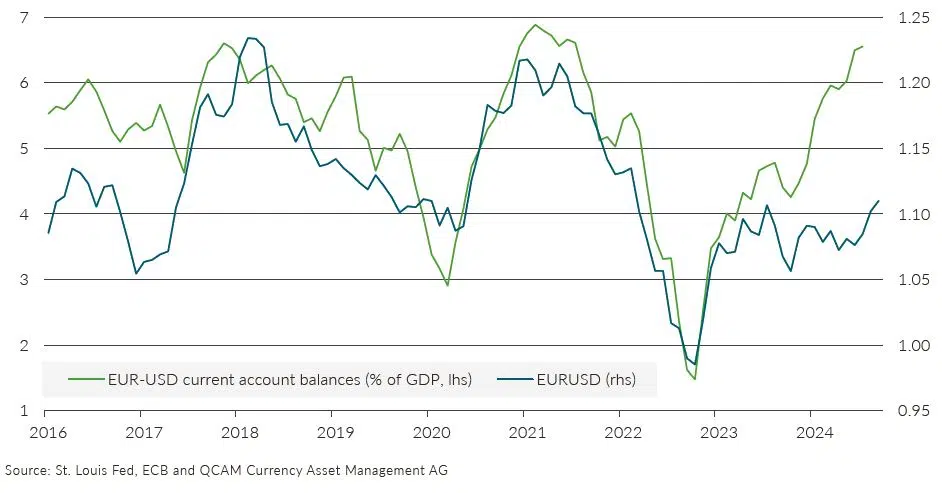
The other concern is the ongoing economic slump in the Euro-area. While the US economy is slowing to a moderate pace, the Euro-area has been stagnating at the brink to recession for nearly two years and there are no signs of imminent improvement. Especially Germany and France are struggling with structural and fiscal impediments and the political situation in both countries has deteriorated to a point that make a quick turnaround unlikely. As a result, the need for monetary stimulus is much larger compared to the US. Against that background, it is surprising how well the EUR is holding up, which may be thanks to the Euro-area’s current account recovery (see chart). This may change once the market realizes that the ECB has to ease more than the Fed.
Finally, there is the US election wild card. The last few weeks before the election as well as the outcome and reaction could raise uncertainty. One result could be a much more restrictive trade policy, especially versus China. This would be bad for everyone, but probably less for the US than for others, which would be USD positive.
High-beta and safe-haven
If the stars all align, risk sentiment improves and the USD enters a broad-based decline, high beta currencies are likely to perform best. Among them, we like the AUD most. Australia is well positioned to benefit from a rise in commodity demand, especially if China does manage a recovery. The Australian economy itself is solid but inflation is running on the high side. As a result, we think the RBA will be slow to follow other central banks in cutting interest rates. We also like safe-haven currencies as a hedge. The CHF stands out but has the handicap that the SNB will probably resist more currency appreciation. In contrast, the new Japanese leadership and the BoJ are not opposed to a JPY recovery, given its huge undervaluation. The Japanese economy is not outperforming but it has held up better than feared. As a result, we expect the BoJ to continue its policy normalization, which means not only raising interest rates but also reducing the balance sheet, which we see as JPY positive over time.

EUR vs. USD current account balances and EURUSD
Economy & Interest Rates
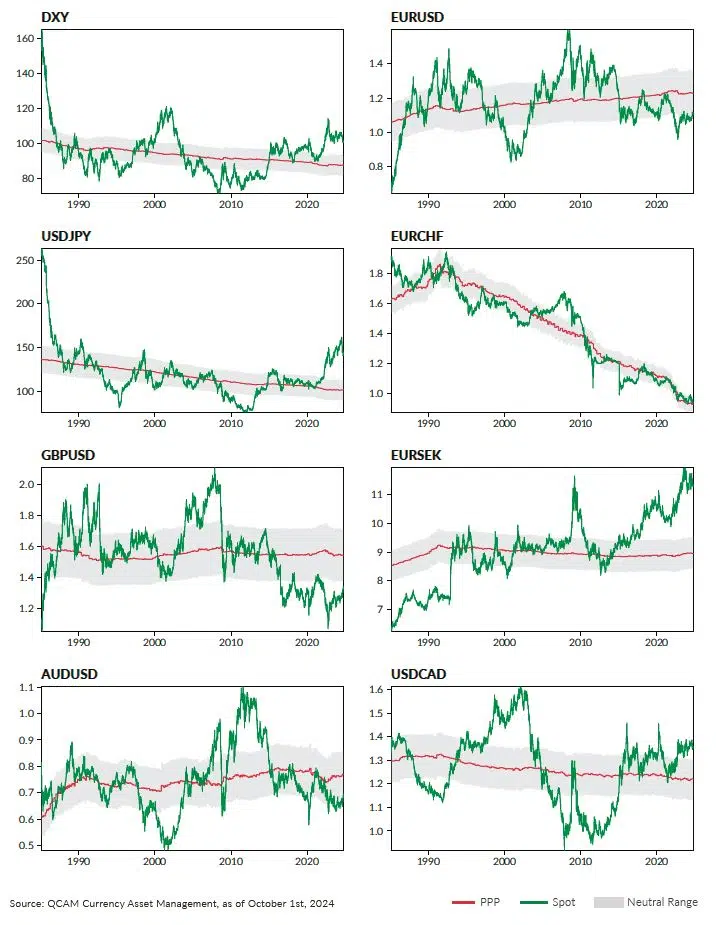
FX Performance vs PPP
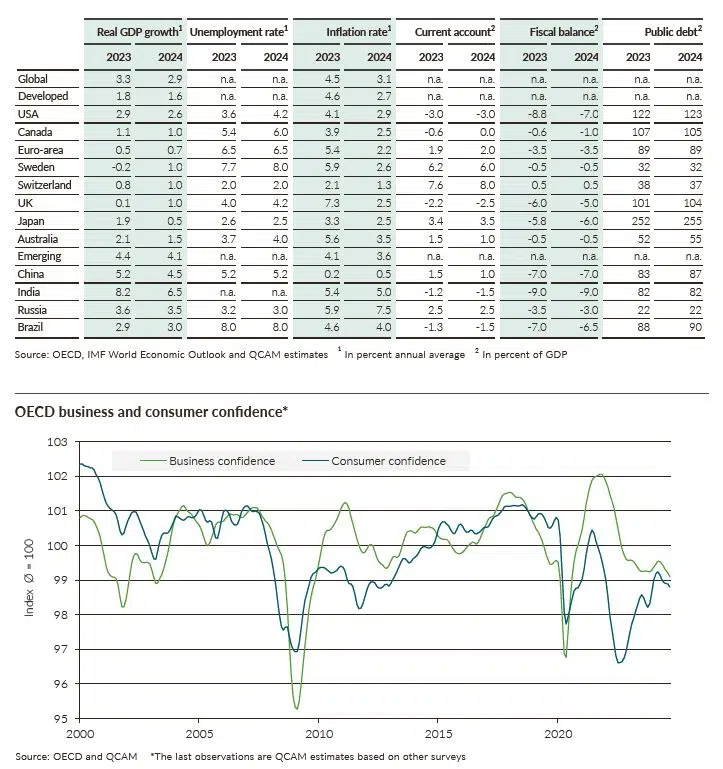
The central outlook scenario remains one of growth moderation and disinflation (soft-landing). The global economy continues to stall but China’s latest stimulus package provides some hope that recovery will resume in 2025. In the US, risks are evenly balanced that the economy will be more resilient or slip into recession. Europe remains the weak link held down by structural and fiscal impediments. Overall, the balance of risks is shifting from inflation to growth, while the process of monetary easing is broadening with the Fed now cutting interest rates as well. Markets are expecting a lot of rate cuts from the Fed and other central banks, which we think is too optimistic.
FX Markets
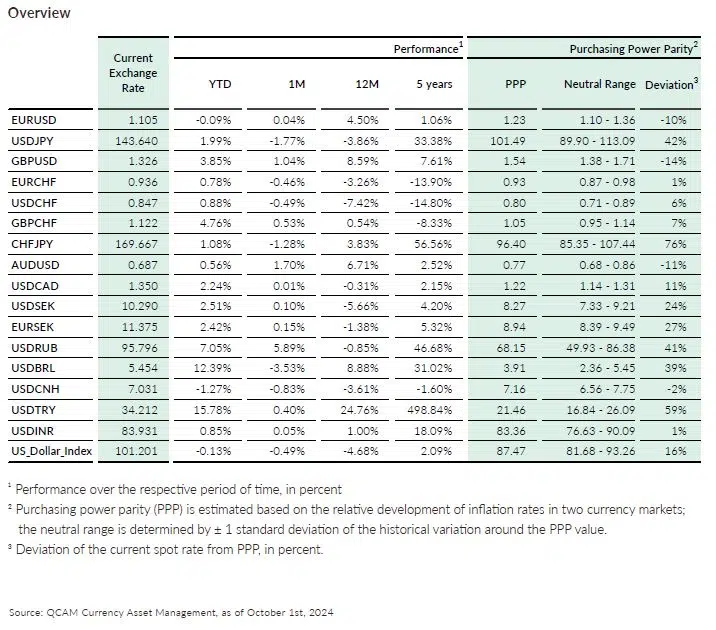
FX Performance vs. PPP
The USD DXY fell 1.1% in September, with high-beta currencies (AUD & GBP) outperforming again. EM currencies also performed well, but with a wider mix. The BRL and the ZAR rallied, while the RUB and the TRY declined. Speculative positions changed significantly, with the USD now oversold and the JPY overbought. Short-term interest rates moved lower and forwards price faster rate cuts from most central banks over the next 12 months. The cost of forward hedging versus the USD has declined further but remains expensive for JPY and CHF. Actual and implied FX volatilities have been mixed but on balance slightly lower and close to their historical averages with USDJPY well above. PPP changes continue to converge as inflation moderates but differences to actual exchange rate levels remain large and the USD continues to be overvalued versus all major currencies except the CHF.
FX Analytics
QCAM has an analytical framework to take scalable exchange rate positions. The QCAM exchange rate strategy for each currency pair has three principle components:
• Macro
• Business Sentiment
• Technical
The positioning signals from each component are aggregated into an overall positioning score for each currency pair.
The Macro component consists typically of economic growth, balance of payments, fiscal and monetary policy and in some cases commodity fundamentals. The positions are either discretionary or model driven.
The Business Sentiment component is a rule-based framework built on business surveys.
The Technical component consists primarily of the technical analysis of daily exchange rates (trend following and mean reversion).
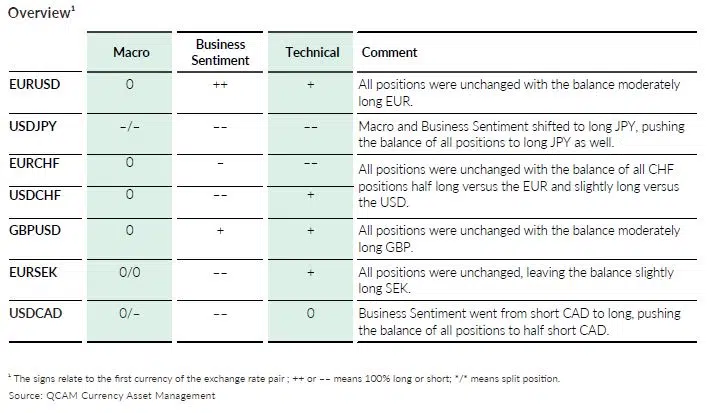
The summary table below and the following pages show the QCAM strategy framework and the positioning for the major currency pairs actively covered by QCAM. The tables break each of the three strategies into subcomponents with an indication of the current impact. The charts show the respective exchange rate with past QCAM positions and their scale.
October 2024 — Current positioning
There have been but some notable position changes since the last QCAM MONTHLY. Most importantly, Macro (both discretionary and interest-rate model) and Business Sentiment went long JPY. In addition, Business Sentiment went long CAD. As a result, all strategy and single currency positions are now short USD with the overall balance of all positions half short USD, led by shorts versus the JPY, the CAD, the GBP and the EUR. The overall EUR position is short versus both the CHF and the SEK.