
The USD weakened further in August as renewed hopes for a soft-landing of the US economy and further Fed rate cut expectations revived the risk-on market sentiment. In the near-term, much will depend on US labor market figures. However, we believe that the market’s Fed rate cut expectations are overdone. If we are right, that should support the USD in the short-term, which would not be unusual for a September month. Medium-term, we think that the USD DXY will stay in the current range.
The USD DXY fell 2.3% in August. The decline occurred in two steps, the first following the weak US labor market report for July and the second after the dovish speech of Fed Chairman Powell at Jackson Hole. However, while risk-off sentiment initially benefitted safe-haven currencies like the JPY and the CHF, better US economic data in the second half of August combined with Fed rate cut expectations shifted sentiment back to risk-on and benefitted riskier currencies like the NZD, the SEK and the AUD. The sell-off pushed the USD DXY to the bottom of the trading range that has prevailed since the start of last year, from where it recovered a bit since the start of September.
Powell ties it all to the labor market
The dovish surprise of Powell’s Jackson Hole speech was his view that economic downside risks have increased, while inflation upside risks have decreased. Specifically, Powell expressed growing confidence that inflation is on a sustainable path back to 2%, because the labor market has cooled, while further cooling in labor market conditions is undesirable. For the market that means, any disappointing labor market figures trigger more rate cuts and, thus, will focus all attention on upcoming job reports, especially before the September 18th Fed meeting (notably the August employment report and the weekly jobless figures).
We agree, that the balance of risks has shifted but the question is by how much and what this means for monetary policy. The labor market is central, but there is more to economic and inflation risks than jobs. The labor market aside, the balance of US real activity data and surveys has not deteriorated over the last few months. Notably, real consumption spending has been rising at a healthy clip from May through July and the Q2 real GDP report was revised up showing continued high profit margins. Thus, bringing inflation sustainably down to 2% will not be easy if spending remains vibrant.
September seasonality
In the near-term, market attention is focused on Fed policy. The Fed is widely expected to start easing on September 18th and to project more interest rate cuts until the end of next year than previously forecasted. Currently, the market looks for 25bps on September 18th with a good chance for 50bps and expects a total of more than 200bps of rate cuts until the end of next year. Given our view on growth and inflation, that much easing is unlikely unless the US economy weakens significantly in the near-term and residual inflation pressures dissolve quickly. As a result, we think the balance of risks points to less rate cuts than the market expects and more USD upside in the near-term, which would not be unusual for a September month.
Indeed, the US equity market has typically sold off and the USD has rallied in September (see table). We find no statistical evidence that supports the view that behind this pattern lies a persistent and independent seasonality. However, we believe that investment and trade behavior facilitate in combination with other factors such an outcome. Over the last three years, it has clearly been inflation concerns and Fed tightening fears that have culminated in September, undermining stocks and boosting the USD. On the other hand, there is no evidence that it is simply a rise in risk aversion that drives stocks lower and the USD higher in September. The VIX and Gold have more often been down than up over the last 10 September months, while Treasury yields have been mostly higher. In other words, the soft-landing scenario and the risk-on sentiment may well persist, but the market may have to dial back its rate cut expectations, which should be enough to push the USD higher in September.
Still range bound
The near-term upside chances of the USD are a tactical opportunity in our view. Strategically, we believe that the USD DXY will stay in the current range, which is shaped by the balance of global and relative growth performances as well as central bank policy paths as outlined in our previous FX Monthlies. As a result, we also keep our strategic macro positions at neutral. Geopolitical conflicts (Middle East and Ukraine) remain significant risk factors. The US election continues to be an open race and the economic implications of the actual outcome are probably less of a risk than the potential response by disappointed voters.

Financial patterns in September over the last 10 years
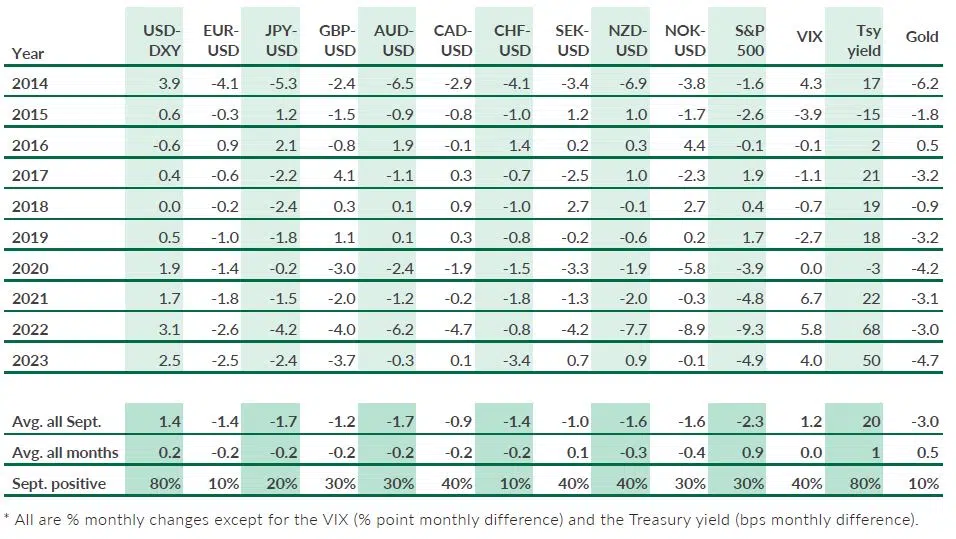
Source: QCAM Currency Asset Management
Economy & Interest Rates
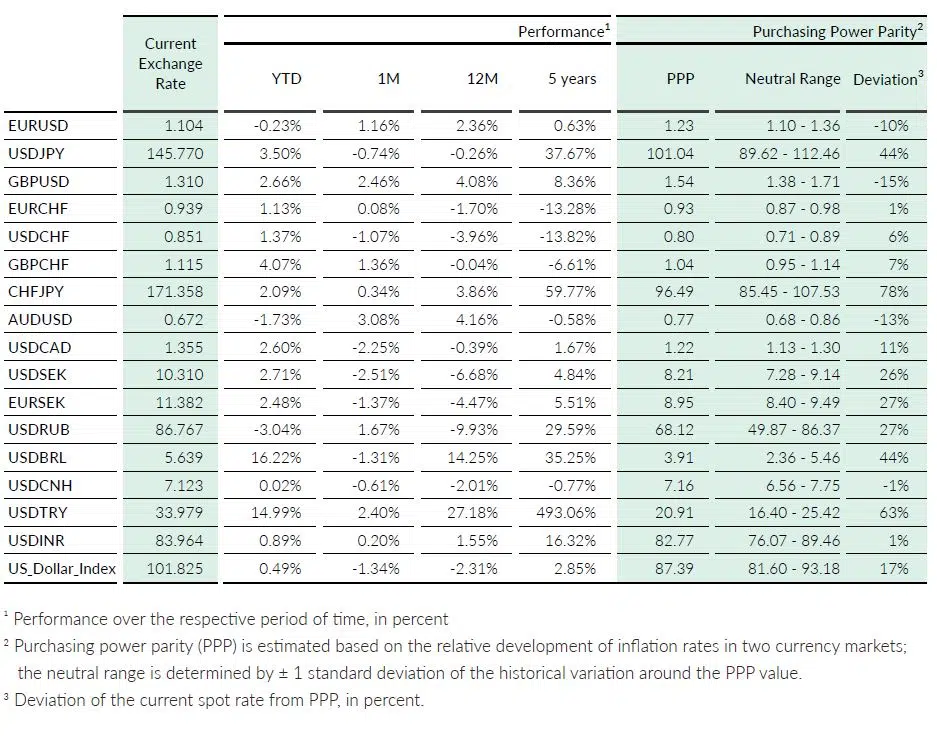
FX Performance vs PPP
Recession fears, especially in the US, are overdone, but signs that the global recovery is stalling are persisting. In our view, the US economy is finally responding to tighter monetary conditions, China continues to struggle with the property crisis and the Euro-area is held down by structural and fiscal impediments. The process of disinflation continues with the latest figures softer after prior bumps. Overall, soft-landing (moderate growth and lower inflation) still remains the most likely scenario for the US and the global economy but uncertainty and the risk of a hard-landing or no-landing with an inflation rebound remain significant. With the balance of risks shifting from inflation to growth, the process of monetary easing is broadening with the Fed now set to join, but we think that the extend of rate cuts will be less than markets expect.

FX Markets
The USD DXY fell 2.3% in August, with high-beta currencies (AUD & GBP) outperforming the safe-haven currencies (CHF & JPY). EM currencies underperformed dragged down by massive declines of the BRL and the TRY. Speculative overbought and oversold positions declined, notably in CHF and JPY and the market is net long USD. Short-term interest rates moved lower and forwards price faster rate cuts from most central banks over the next 12 months. The cost of forward hedging versus the USD has declined but remains expensive for JPY and CHF. Actual and implied FX volatilities increased across the board and on balance have come close to their historical averages with USDJPY well above. PPP changes continue to converge as inflation moderates but differences to actual exchange rate levels remain large and the USD continues to be overvalued versus all major currencies except the CHF.
FX Analytics
QCAM has an analytical framework to take scalable exchange rate positions. The QCAM exchange rate strategy for each currency pair has three principle components:
• Macro
• Business Sentiment
• Technical
The positioning signals from each component are aggregated into an overall positioning score for each currency pair.
The Macro component consists typically of economic growth, balance of payments, fiscal and monetary policy and in some cases commodity fundamentals. The positions are either discretionary or model driven.
The Business Sentiment component is a rule-based framework built on business surveys.
The Technical component consists primarily of the technical analysis of daily exchange rates (trend following and mean reversion).
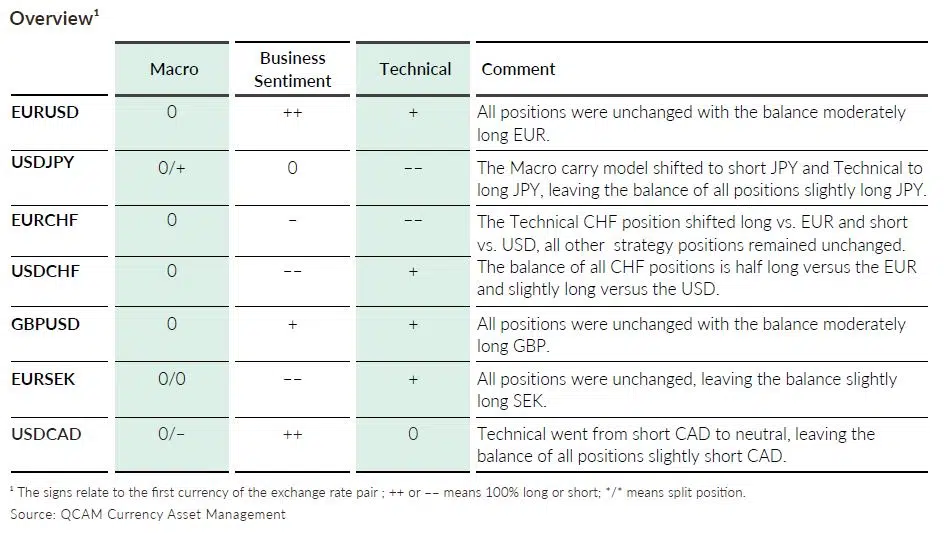
The summary table below and the following pages show the QCAM strategy framework and the positioning for the major currency pairs actively covered by QCAM. The tables break each of the three strategies into subcomponents with an indication of the current impact. The charts show the respective exchange rate with past QCAM positions and their scale.
September 2024 / Current Positioning
There have been few position changes since the last QCAM MONTHLY. On the discretionary Macro side, we kept all positions at neutral as we expect continued range trading. Business Sentiment positions also remained unchanged with the balance modestly short USD. Technical went long JPY, neutral CAD, long CHF vs EUR and short CHF vs USD. The balance of all Technical positions is also moderately short USD. As a result, the balance of all strategy positions is moderately short USD as well, led by shorts versus the GBP and the EUR. The only remaining long USD position is versus the CAD, although small. The EUR is short versus the CHF and the SEK.