
The USD continued to rise in April as Fed rate cut expectations were further curtailed and thanks to the BoJ not sounding concerned about JPY weakness. We think the USD will be range-bound going forward as US exceptionalism gradually fades while the Fed trails rather than leads the easing cycle. We have lost confidence that the BoJ will outline a tightening cycle that is supportive for the JPY.
The USD DXY rallied 1.8% in April with a diverging performance versus other major currencies. The USD gained most versus the JPY, which collapsed following the latest BoJ meeting after which Governor Ueda showed little concern over JPY weakness. On the other hand, commodity currencies performed better, notably the NOK. EM currencies led by the CNY outperformed most of their major piers supported by better economic news from China and higher commodity prices.
So far, we have framed our FX outlook for 2024 along two criteria: 1) relative growth performance in a global recovery and 2) relative timing and scale of central bank easing. Up until now, the balance has favored the USD thanks to its economic outperformance and the push-back of Fed easing. We still think the Fed will trail rather than lead the easing cycle but the latest round of data puts into question whether US exceptionalism will prevail.
Fading US exceptionalism
The falling momentum of the US versus the rest of the world is best seen in the GDP data. In the second half of last year, the US economy grew more than 4% annualized, while the Euro-area, the UK and Japan entered mild recessions. In the first quarter of this year, US real GDP growth dropped by two thirds, while the Euro-area, the UK and Japan all managed to exit recession with growth rates not much below that of the US. Moreover, EM real GDP growth rebounded in the first quarter led by a bounce in China. Early April data – notably the ISM figures report and the payroll report – suggest that the slowdown in US economic activity is spreading into the second quarter.
To be sure, we are not expecting a reversal with the US underperforming the rest of the world going forward. In our view, ongoing US growth is important for the global recovery to continue. Also, we see the US economy as less structurally burdened, especially compared with the major economies in Europe. More likely, we expect the US growth performance to fall in line with the rest of the world, which is also becoming visible in the equity markets.
But USD yield advantage persists
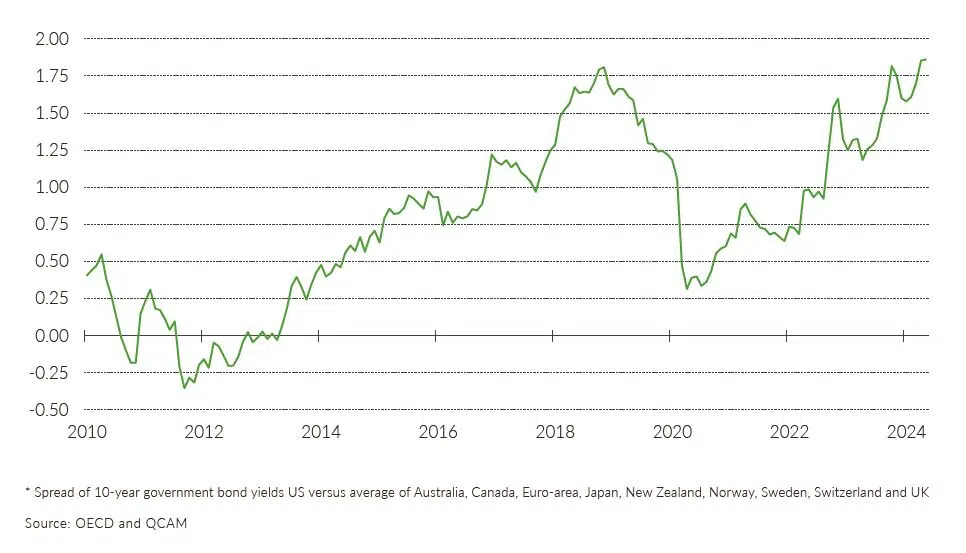
On the other hand, the USD’s yield advantage versus all other major currencies has prevailed (see chart) and we think this will not change anytime soon. Inflation in the US was elevated in the hard data through March and prices paid measures in the latest surveys suggest that this continued through April. Fed Chair Powell was not willing to rule out rate cuts later this year but he also made clear that any move would depend on significant inflation improvements. In our view, green light is unlikely to emerge before the fourth quarter, if at all this year. Meanwhile, European inflation data has generally surprised on the low side including the latest April data and we expect European central banks to start cutting rates at the end of the second quarter (see also previous issue of the QCAM MONTHLY).
In the very near term, markets may focus more on the fading US exceptionalism and also hope that the Fed may ease earlier. That could put the USD under pressure temporarily, also given the USD’s overbought position in the futures market. If we are right and the yield advantage prevails, however, we expect the USD to remain range bound and not enter a bear market.
Losing patience with the BoJ
We have been constructive on the JPY for more than a year on the view that the BoJ has to normalize policy. We held on to the view even though the BoJ was visibly dragging its feet. To us, the risk-reward tradeoff seemed acceptable. We still believe that the potential reward is large but our view on the risk has changed since the last BoJ meeting. In the press conference Governor Ueda made unequivocally clear that he is in no hurry to move interest rates towards neutral or reduce the BoJ’s massive balance sheet and was also openly unfazed by JPY weakness.
Ueda may regret his sloppy statement in hindsight, but it revealed his and the BoJ’s general attitude towards the JPY – on balance JPY weakness is still seen as more beneficiary than harmful. Thus, even though MoF intervention helped stabilize the JPY, the market will probably test JPY downside again and we fear that intervention is unlikely to be a sustainable defense. As a result, we have decided to step to the sideline and wait for the BoJ to outline a credible tightening path that normalizes policy in a straightforward timeframe.
A few decades ago, the extent of the JPY’s current depreciation would have triggered tensions within the G7 but not now, which underlines Japan’s decline as an important trading partner and competitor, especially for the US. China has long overtaken that position. However, JPY weakness is a problem within Asia but the region lacks cooperative structures to resolve such issues.

Economy & Interest Rates
Global growth conditions continue to improve gradually but US outperformance has narrowed. The process of disinflation remains uneven, with more progress in Europe and setbacks in the US. Soft-landing (moderate growth and lower inflation) remains the favored scenario of the market for the US as well as most of the rest of the world. However, uncertainty and the risk of a hard-landing or no-landing with an inflation rebound remain significant, leaving a range of possible monetary policy implications. In our view, most easing is likely to occur in Europe led by the ECB, while the Fed will probably ease later and less. The BoJ is expected to tighten policy but not forcefully (see also article above).
FX Markets
FX Performance vs. PPP
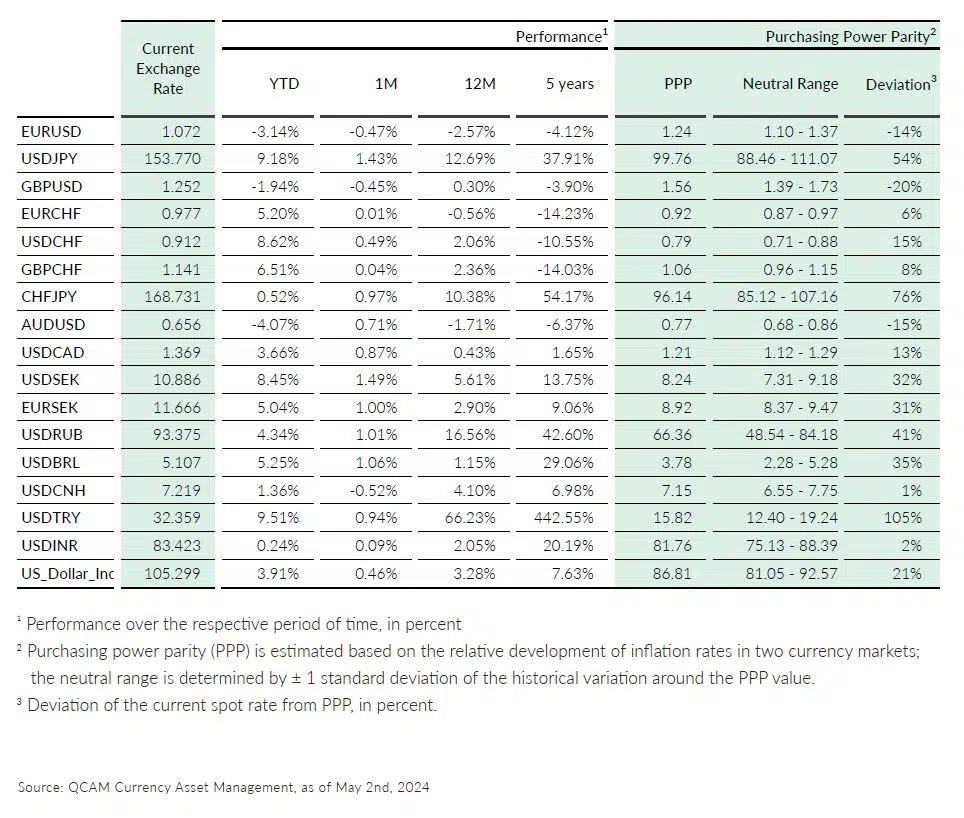
The USD DXY rose 1.8% in April, but with a wide performance spread. The JPY was the worst performer, down nearly 4% in April. EM currencies on balance held up better than major currencies with even the TKY taking a break from its perennial decline. Overall speculative positions moved from neutral to overweight USD with the JPY and the CHF looking most oversold. Short-term interest rates were mostly stable yet forwards now price more rate cuts for the EUR versus the USD. The cost of forward hedging versus the USD has stabilized but remains expensive especially for JPY and CHF. Actual and implied FX volatilities were mostly stable and on balance remain below historical levels with the notable exception USDJPY. PPP changes continue to converge as inflation moderates but differences to actual exchange rate levels remain large and the USD continues to be overvalued versus all major currencies.
FX Analytics
QCAM has developed an analytical framework to take scalable exchange rate positions. The QCAM exchange rate strategy for each currency pair has three principal components:
• Macro
• Business Sentiment
• Technical
The positioning signals from each component are aggregated into an overall positioning score for each currency pair. This score is used for the dynamic exposure management.
The Macro component consists typically of economic growth, balance of payments, fiscal and monetary policy and in some cases commodity fundamentals. The positions are either discretionary or model driven.
The Business Sentiment component is a rule-based framework built on business surveys.
The Technical component consists primarily of the technical analysis of daily exchange rates (trend following and mean reversion). We also consider speculative futures positions and the deviation of exchange rates from purchasing power parity.
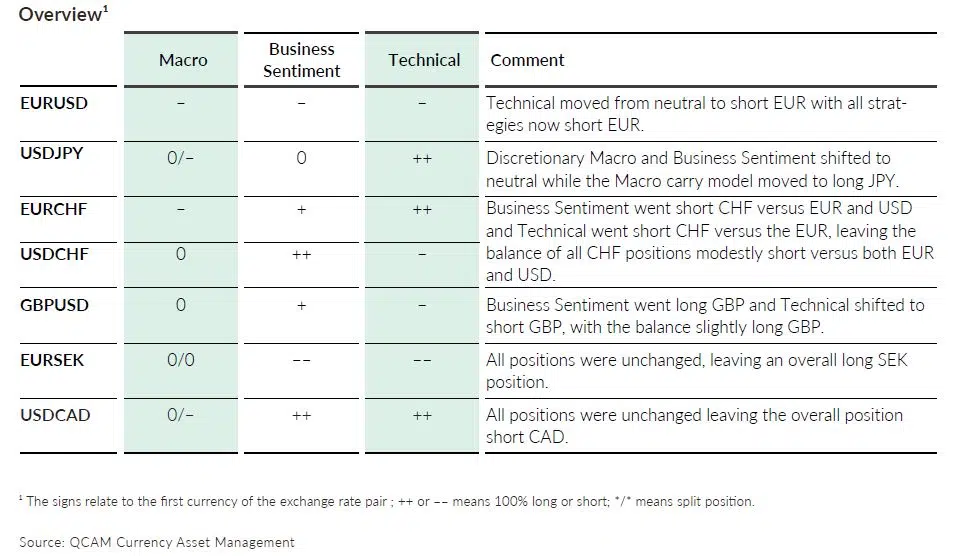
The summary table below and the following pages show the QCAM strategy framework and the positioning for the major currency pairs actively covered by QCAM. The tables break each of the three strategies into subcomponents with an indication of the current impact. The charts show the respective exchange rate with past QCAM positions and their scale.
May 2024 / Current positioning
The balance of all positions remains modestly long USD. On the discretionary Macro side, we went from long JPY versus the USD to neutral. Business Sentiment went neutral USDJPY, short the CHF versus the EUR and the USD and long GBPUSD. On balance, Business Sentiment remains long USD. Technical went short EURUSD, long EURCHF and short GBPUSD. The overall USD position remains long versus all other currencies, led by longs versus the EUR and the CAD. The EUR is long versus the CHF and short versus the SEK.