

The USD weakened in May as hopes for more Fed rate cuts before year end reemerged. In our view, this is not a fundamental change but a move within the range. The outcome of the next US labor market and inflation reports as well as the FOMC meeting may lead to more USD downside in the near-term, but we believe the range will hold, thanks to the USD’s yield and safe-haven appeal.
The USD DXY slipped 1.5% in May and started June on the weak side as well. The USD decline was broad based versus other major currencies but with significant variations. EUR and JPY gains roughly matched USD’s losses, but SEK and NOK outperformed significantly while the CAD only rose slightly versus the USD. The USD held up better versus emerging market currencies with the RUB gaining the most while the BRL actually weakened. Risk-on sentiment dominated markets in the first half of May with the VIX and implied FX volatility falling after the rise in April, but were more mixed lately.
In our view, the recent USD weakness was triggered by two developments. First, a repricing of the relative central bank easing paths expected by the market. Notably, softer April inflation figures for the US increased hopes that the Fed will cut 25 to 50 bps before the end of the year, while firmer Euro-area inflation data for May poured some cold water on forecasts that the ECB may make several back-to-back rate cuts after the widely anticipated first rate cut this week. Second, more signs that US exceptionalism is fading in a global recovery environment. In our view, these developments could drag the USD further down in the near-term supported by investors overextended USD long positions, but are not strong enough to power a persistent USD bear trend that breaks through the current range, which we see between 101 and 106 for the USD DXY and 1.05 and 1.10 for EURUSD.
We have been here before
Ups and downs within the range have been the standard pattern for the USD DXY since the start of last year (see Chart). Changes in market expectations of relative monetary policy trajectories have been powerful short-term FX drivers, but not trend-setters. Late last year, softer US inflation data and dovish Fed commentary caused the USD DXY to fall from the top of the range to the bottom. Subsequent inflation disappointments earlier this year caused a reversal. Interestingly, while the Fed fueled the market sentiment at the end of last year with dovish comments and its own anticipation of more rate cuts, there has been no similar reaction so far this time.
This Friday’s US labor market report and next week’s US CPI report and FOMC meeting, both scheduled for June 12th, will probably determine the near-term direction for the USD. Signs of labor market and inflation cooling or resilience are likely to either increase or reduce Fed rate cut expectations. The result could be a USD selloff similar to those at the ends of 2022 and 2023 or a USD rebound to the top end of the range. Whether the Fed will amplify or temper the market reaction later in the day on June 12th is unclear, but we expect that FOMC members will moderate the path of expected rate cuts in their Summary of Economic Projections, which would be USD friendly. Given the near-term uncertainties, our discretionary macro positions are currently mostly neutral.
USD yield advantage to persist
Irrespective of the outcome of the labor market and inflation reports as well as the FOMC meeting, we believe the USD will retain its yield and carry advantage. The USD is at the top end of the interest rate and yield spectrum among major currencies. At the moment, interest-rate forwards imply more rate cuts in the US versus most other developed economies until the end of next year. For example, the Fed is expected to cut at least 25bps more than the ECB until the end of 2025 although the ECB is forecasted to start cutting interest rates several months before the Fed. Even if realized, that would still leave the USD with a comfortable interest rate and yield advantage relative to the EUR.
In our view, however, chances are higher that the ECB will end up easing more than the Fed. We think that inflation resilience especially in services and housing is stronger in the US, while the pressure to stimulate the economy is greater in the Euro area. Yes, the Euro-area is recovering but unevenly and from a level of subpar activity, while the US is slowing but from a state of overheating. As a result, we expect the ECB to pause only briefly after the initial rate cut in June and resume the easing process in September, while we think that the Fed will at best start the easing cycle in September and probably be more cautious, especially around the US elections.
Super safe haven
One development of the last few years has been the return of the USD as the world’s predominant safe-haven currency, pushing EUR and JPY into irrelevance and tolerating only the CHF as a smaller brother. Given the fault-lines and conflicting interests behind the current geopolitical tensions, we believe the USD will retain its super safe-haven status for some time longer. The risk is that the outcome of the US election will increase the tensions, but not through a weak USD policy but through more trade restrictions.

Source: investing.com and QCAM
Economy & Interest Rates
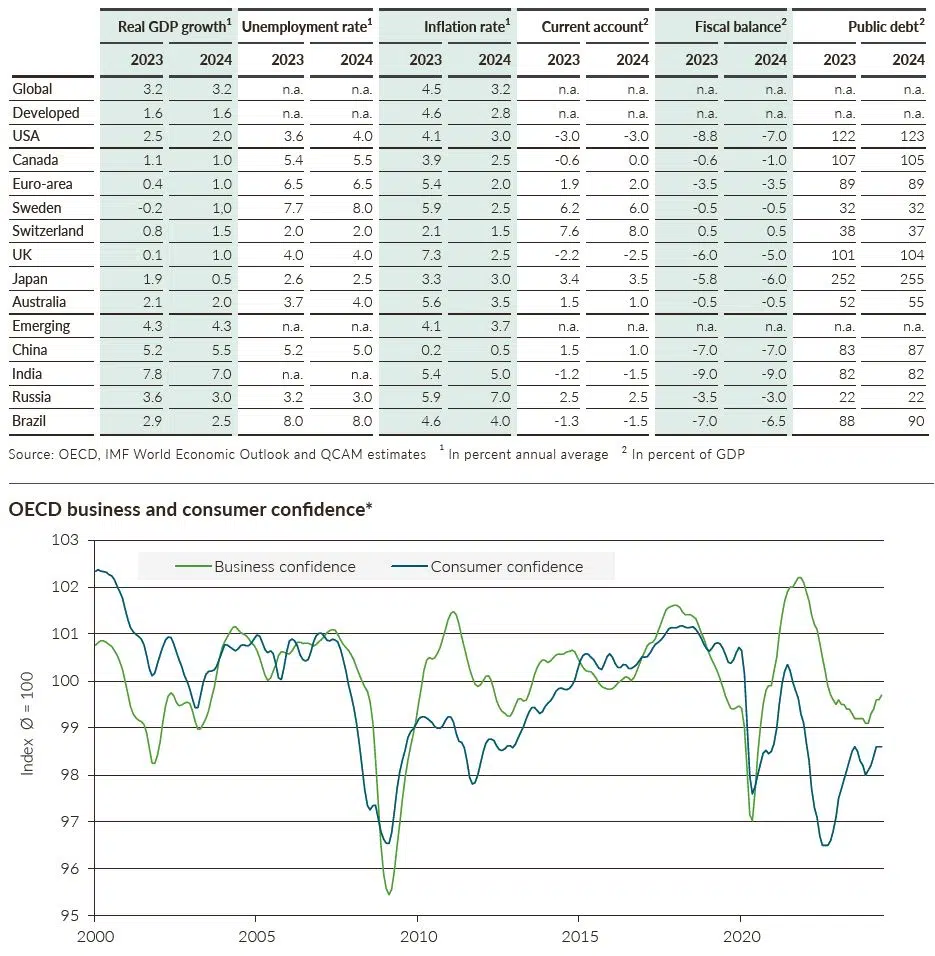
Global growth conditions continue to improve slowly with US outperformance narrowing. Notably, growth forecasts in Europe have been raised. The process of disinflation remains bumpy. Latest figures have been a bit softer in the US and a bit firmer in Europe. Overall, soft-landing (moderate growth and lower inflation) remains the favored scenario of the market for the US and the global economy. However, uncertainty and the risk of a hard-landing or no-landing with an inflation rebound remain significant, leaving a range of possible monetary policy implications. In our view, most easing is likely to occur in Europe led by the ECB, while the Fed will probably ease later and less. The BoJ is expected to tighten policy but not forcefully.
FX Markets
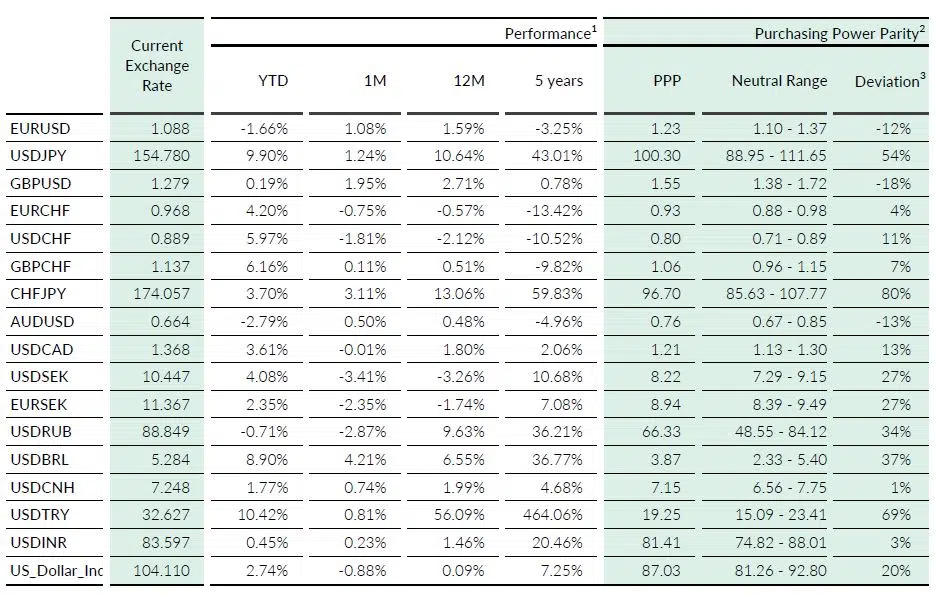
The USD DXY fell 1.5% in May, but with uneven losses versus other major currencies. The SEK performed by far the best, while the CAD trailed most behind. EM currencies underperformed on balance their major peers. Overall speculative positions remained overweight USD with the JPY and the CHF looking most oversold. Short-term interest rates moved a bit lower and forwards price more rate cuts from most central banks over the next 12 months. The cost of forward hedging versus the USD has declined but remains expensive especially for JPY and CHF. Actual FX volatilities were mixed yet implied FX volatilities mostly declined and on balance remain below historical levels with the notable exception of USDJPY. PPP changes continue to converge as inflation moderates but differences to actual exchange rate levels remain large and the USD continues to be overvalued versus all major currencies.
FX Analytics
QCAM has developed an analytical framework to take scalable exchange rate positions. The QCAM exchange rate strategy for each currency pair has three principal components:
• Macro
• Business Sentiment
• Technical
The positioning signals from each component are aggregated into an overall positioning score for each currency pair. This score is used for the dynamic exposure management.
The Macro component consists typically of economic growth, balance of payments, fiscal and monetary policy and in some cases commodity fundamentals. The positions are either discretionary or model driven.
The Business Sentiment component is a rule-based framework built on business surveys.
The Technical component consists primarily of the technical analysis of daily exchange rates (trend following and mean reversion). We also consider speculative futures positions and the deviation of exchange rates from purchasing power parity.
The summary table below and the following pages show the QCAM strategy framework and the positioning for the major currency pairs actively covered by QCAM. The tables break each of the three strategies into subcomponents with an indication of the current impact. The charts show the respective exchange rate with past QCAM positions and their scale.
Current positioning — June 2024
There have been a few signal changes since last month pushing the balance of all positions from modestly long to modestly short USD. On the discretionary Macro side, we shifted the EUR position to neutral. Business Sentiment went long EUR and CHF versus the USD and short JPY. On balance, Business Sentiment is now modestly short USD. Technical went long GBP, short SEK and neutral CAD. Overall, the modest USD long position versus all other currencies shifted to a small short, led by shorts versus the CHF, the EUR and the GBP. The main offset is the long USD position versus the JPY. The EUR is long versus the CHF and neutral versus the SEK.

Source: QCAM Currency Asset Management